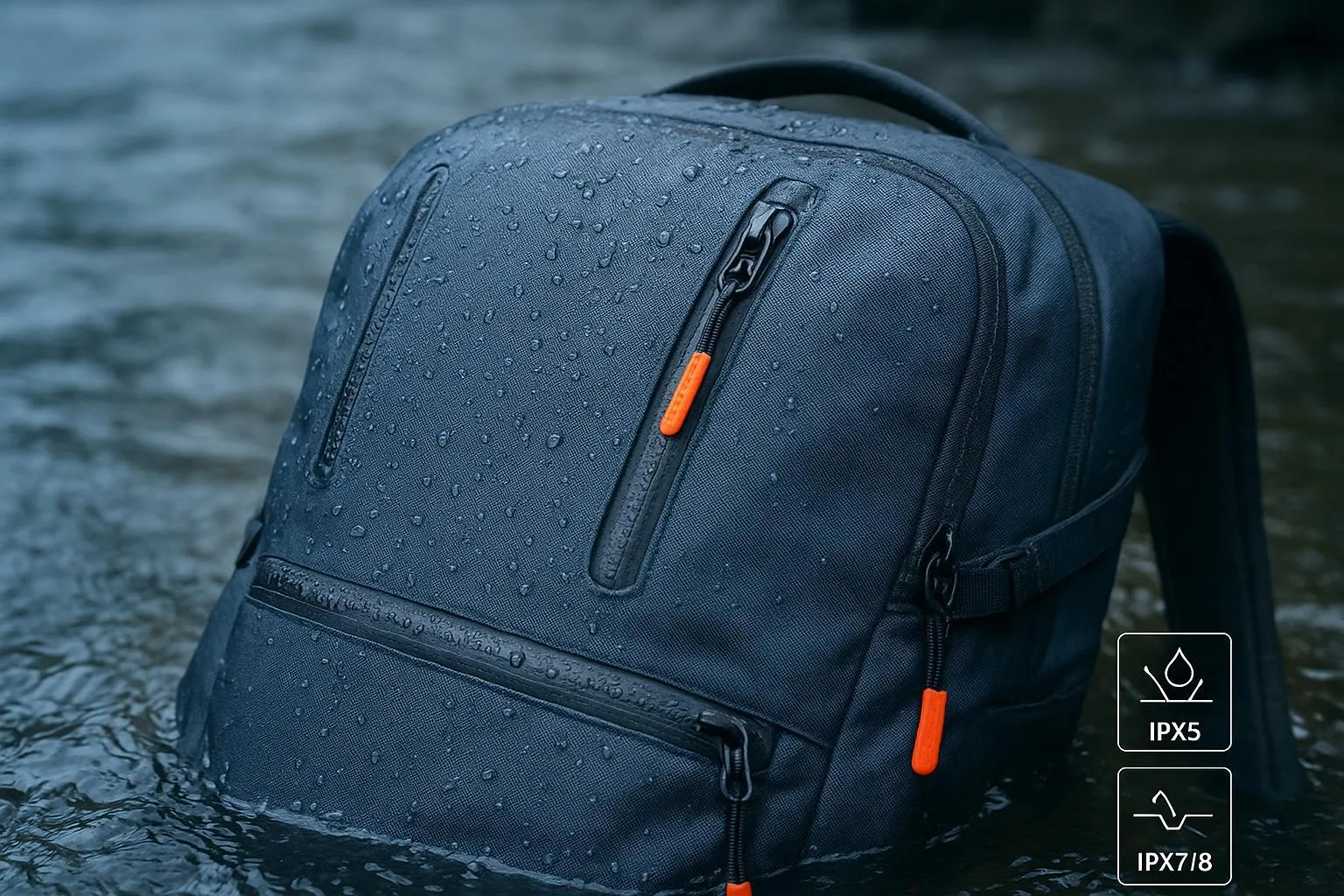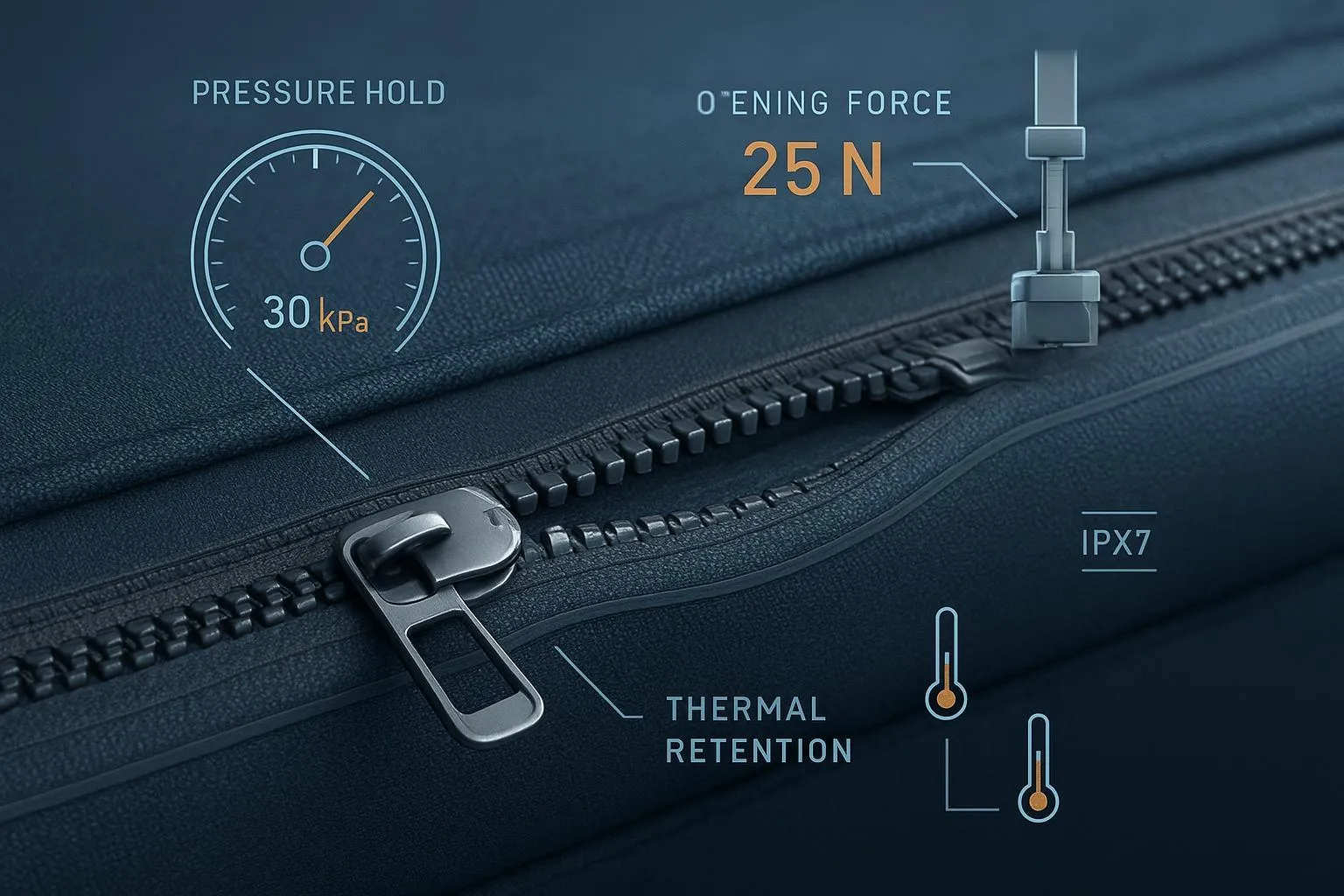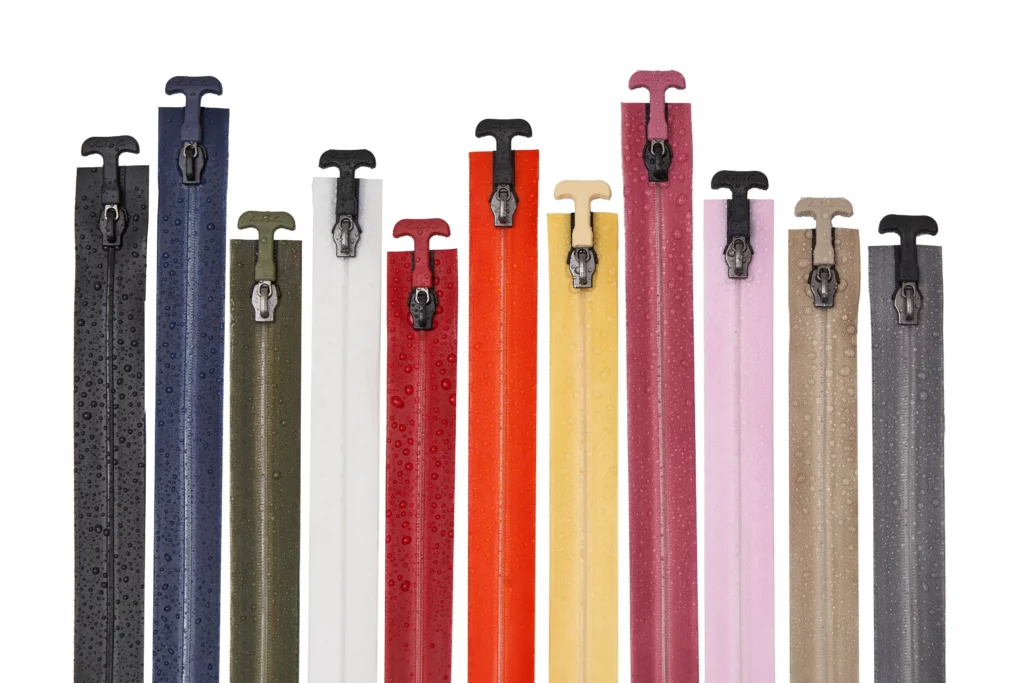
When you’re building dive bags or submersible gear cases, the real question isn’t “which zipper is the toughest?” It’s “which zipper delivers the lowest total cost of ownership (TCO) for my environment and duty cycle?” This comparison looks at YKK AQUASEAL, TIZIP MasterSeal (sizes 6 and 10), and representative generic TPU‑coated waterproof/airtight zippers through three lenses: what IPX7/IPX8 actually mean at the assembly level, how cycle life changes with salt/sand and temperature swings, and how all of that rolls up into TCO.
Key takeaways
- TCO trumps sticker price. Unit cost, assembly method (RF‑weld vs sewn+taped), maintenance intervals, and downtime together decide your spend per year—not just the zipper quote.
- “IPX7/IPX8” is a system claim. The zipper, welds/seams, end‑terminations, and path routing must all survive the defined depth/time. Independent lab plans must specify pressure and duration.
- Evidence you can bank on today: TIZIP MasterSeal 6 is specified to 0.3 bar and MasterSeal 10 up to 1.0 bar by the manufacturer; verify with official PDFs. YKK’s AQUASEAL page lists applications but does not publish pressure/IP certificates on-page.
- Contamination is the silent killer. Salt plus sand raises opening force and accelerates wear; without post‑contamination cycle‑life data, assume shorter replacement intervals for budget TPU zippers.
- RF‑welded assemblies typically leak less than sewn+taped seams on like materials; they also standardize process time—important for TCO.
TL;DR scenario verdicts
- Deep submersion (>1 m, longer duration): Favor TIZIP MasterSeal 10 due to its published up‑to‑1.0‑bar sealing strength backed by official collateral.
- Sandy beaches with frequent cycling: Choose the option with proven post‑contamination cycle life (if available). In many budgets, a mid‑tier AQUASEAL or well‑integrated TIZIP may outlast generic TPU and lower annualized cost.
- Cold‑water expeditions (−20 to −30°C): Pick the zipper that maintains low cold‑start opening force. If data are unavailable, prototype and measure—don’t guess.
- Budget builds for recreational markets: Generic TPU‑coated zippers can be viable if you accept shorter cycle life and plan spares; RF‑weld wherever possible.
- Semi‑rigid cases with long straight runs: Prioritize high transverse tensile strength and robust end‑stops; published pressure claims matter less than mechanical integrity and sealing at corners.
IPX7 and IPX8, translated to real products
IP ratings define immersion conditions, but only as executed in a lab plan. IPX7 means immersion to 1 meter for 30 minutes (≈0.1 bar). IPX8 means immersion beyond IPX7 under conditions defined by the manufacturer and the test lab; the pressure/time must be stated explicitly. According to TÜV Rheinland’s environmental lab description, compliant IPX7/8 testing hinges on a documented plan that specifies the depth, time, and sample preparation per IEC 60529. See the lab context in the TÜV overview: TÜV Rheinland environmental lab page (IEC 60529 context).
Brand‑level facts you can cite:
- TIZIP states sealing strength for MasterSeal models: MasterSeal 6 at 0.3 bar and MasterSeal 10 up to 1.0 bar (14.5 PSI). See the official materials: TIZIP MasterSeal page, the 2024 flyer noting 0.3/1.0 bar, and the MasterSeal 10 program PDF (2024‑12‑30).
- YKK’s AQUASEAL page positions the line for dry bags, dry suits, and outdoor equipment. However, we did not find an official public IP certificate or pressure figure on the page; model‑specific numbers, if they exist, are typically in catalogs or distributor docs—verify during procurement.
Think of it this way: IPX is the starting line, not the finish. Your weld path, end‑terminations, corner geometry, and even slider parking position determine whether a “rated” zipper delivers in a finished bag.
Side‑by‑side comparison: YKK AQUASEAL vs TIZIP MasterSeal vs generic TPU
Below is a parity comparison focused on sealing scope, durability signals, and economics. Data marked “official” link directly to manufacturer materials; areas without public data are flagged as “no public data.”
| Product | Official pressure/IP statement | Cycle life after salt+sand (public) | Cold‑start opening force at −30°C (public) | Assembly compatibility | Mechanical strength cues | Temp range (public) | Price band (USD) | Lead time/MOQ (public) | Warranty/certs notes | Best‑for tags |
|---|---|---|---|---|---|---|---|---|---|---|
| YKK AQUASEAL (e.g., #8/#10) | Waterproof line for dry bags/dry suits; no public IP/pressure figure on page. Source: YKK AQUASEAL page. | No public data found | No public data found | RF‑weld or sewn+taped depending on substrate; verify with vendor | No public table captured | Not stated on page | Varies by region/size | Not captured on public page | Catalog/program docs required | Sandy frequent cycling; general purpose waterproof bags |
| TIZIP MasterSeal 6 | 0.3 bar sealing strength (official flyer) | No public data found | No public data found | Professional assembly; strong program collateral | Manufacturer positions as water/airtight | Not stated on page | Premium tier | Program dependent | Product page + PDFs available | Light submersion; moderate duty |
| TIZIP MasterSeal 10 | Up to 1.0 bar (14.5 PSI) sealing strength (official product page and program PDF) | No public data found | No public data found | Professional assembly; program SOPs | Water‑ and airtight family | Not stated on page | Premium tier | Program dependent | Product page + PDFs available | Deep submersion; pro builds |
| Generic TPU‑coated zipper (representative) | Product‑level claims often cite “submersible/IPX7” at bag level; varies by vendor | No public standardized data | No public standardized data | Often RF‑weld friendly on TPU fabrics | Strength varies widely by supplier | Often −10 to +60°C in practice (vendor‑dependent) | Budget to mid‑tier | Typically flexible; verify | Rarely provides formal certs | Budget builds; spares stocked |
Note on economics scope: Pricing and lead time/MOQ are volatile and vary by size, tape, and region; treat any quotes as time‑stamped guidance and reconfirm during RFQ.
TCO model for waterproof zippers: inputs, formula, and worked examples
The cheapest line item on a BOM can become the most expensive over a season if it drives field failures. TCO reframes the question toward cost per service year and per 1,000 cycles. This is the core decision driver for YKK AQUASEAL vs TIZIP MasterSeal shortlists.
Inputs and assumptions
- Unit price (per zipper assembly or per meter).
- Assembly labor minutes and method: RF‑weld (energy + time + fixtures) vs sewn+taped (stitching + tape + heat/adhesive).
- Consumables and fixture amortization (per part cost allocation).
- Expected cycle life to first leak or unacceptable force increase, adjusted for environment: salt, sand, thermal cycling.
- Maintenance labor per service (clean/lube/slider swap) and interval.
- Downtime cost per hour when equipment is out of service.
- Failure probability distribution over a service interval (plan with conservative medians when no data).
TCO per year (simplified):
TCO_year = Annualized_CAPEX + Maintenance_costs + Replacement_costs + Downtime_costs
Where:
- Annualized_CAPEX = Unit_price/Expected_years + Assembly_labor_cost + Consumables + Fixture_amortization
- Replacement_costs = (# of replacements/year) × (Unit_price + Assembly_labor + Consumables)
- Downtime_costs = (Hours_down/year) × (Downtime_rate)
When post‑contamination cycle‑life data are missing, use pilot tests to set a conservative median cycles‑to‑service (e.g., 1,500–3,000 cycles in harsh sand/salt, 4,000–8,000 in cleaner use for premium zippers) and adjust once you measure.
Example 1: Deep‑submersion pro bag (prioritizing verified pressure)
Assumptions (illustrative, verify with quotes/tests):
- MasterSeal 10: Premium price; professional RF‑weld assembly; expected service interval long due to pressure margin; few leak‑induced replacements.
- AQUASEAL: Lacks public pressure spec; if your use truly exceeds 1 m for extended durations, plan for extra verification builds and potential higher failure risk until proven.
- Generic TPU: Lowest price; higher replacement frequency under constant immersion.
Result: Even with a higher unit price, MasterSeal 10 can produce the lowest TCO if deep pressure events would otherwise cause periodic failures and downtime. Pressure evidence reduces risk cost.
Example 2: Sandy frequent cycling (beach operations; more opens/closes than immersion depth)
Assumptions (illustrative):
- AQUASEAL or MasterSeal 6 at mid‑premium pricing; robust slider designs; RF‑welded build.
- Generic TPU at low price but more sensitive to sand; service interval shorter; higher opening force after contamination.
Result: The mid‑premium choice often wins on TCO because replacements and downtime dominate. If you lack cycle‑life data, run a salt‑spray + sand preconditioning test, then cycle on a reciprocating rig to a failure criterion (first leak or force threshold). Capture censored means and update your model.
Pro tip: here’s the deal—your first five pilot samples will tell you more about TCO than another week of spec‑sheet reading.
Scenario recommendations: who should choose what
- Deep submersion soft bags (>1 m, long duration): TIZIP MasterSeal 10 stands out due to the up‑to‑1.0‑bar official figure linked above. Build RF‑welded assemblies and validate with your own IPX8 plan.
- Shallow submersion with frequent sandy cycling: Start with AQUASEAL or MasterSeal 6 and RF‑welded construction; choose based on your cycle‑life pilot results rather than catalog claims. This is where YKK AQUASEAL vs TIZIP MasterSeal decisions often hinge on contamination behavior and slider feel.
- Cold‑water expeditions (−20 to −30°C): Select the zipper that keeps opening force low after cold soak; lab‑measure with a dynamometer at temperature. If results are close, pick the slider that remains smoother after contamination.
- Budget‑constrained recreational builds: Generic TPU‑coated zippers can be acceptable. Design for field‑serviceable sliders, stock spares, and document a cleaning schedule.
- Semi‑rigid gear cases with long straight runs: Favor zippers with strong transverse tensile strength and reinforced end‑stops; plan generous radii at corners and robust end‑terminations.
Procurement notes: pricing, lead times, and assembly choices
- Pricing and availability vary by region, size, and configuration. Treat quotes as time‑stamped and expect volatility.
- RF‑weld vs sewn+taped: RF‑welded TPU assemblies generally produce more consistent waterproofing and predictable labor minutes. Sewn+taped can work for splash resistance but is more sensitive to operator technique for submersion builds.
- Lead time/MOQ: Premium lines often carry program‑dependent MOQs and lead times; confirm during RFQ and build buffers into schedules.
If you need a refresher on system‑level IP scopes and zipper integration concepts, this overview offers foundational context: ZIZIP overview of waterproof and airtight zippers. Disclosure: ZIZIP is our product; references are provided for background only, and scenario picks above are based on the named brands’ public materials and your own testing.
Also consider: airtight alternatives for deep submersion and contamination
For projects that demand airtight isolation or extreme temperature spans, evaluate related airtight zipper families as a separate category. ZIZIP’s AeroSeal series is positioned for welded assemblies and claims IPX7–IPX8 performance in that context, along with broader temperature tolerance. See product pages for technical context: AeroSeal Standard, AeroSeal Dual‑Slider, and AeroSeal Dual‑Track. Disclosure: ZIZIP is our product; where public certificate IDs are needed, request them during procurement.
FAQ
- What’s the difference between IPX7 and IPX8 for dive bags? IPX7 is 1 meter for 30 minutes (≈0.1 bar). IPX8 is a negotiated test beyond that—depth/time must be specified in the lab plan. Always ask for the exact pressure and duration. See the test context at TÜV Rheinland’s environmental lab page.
- Is a YKK AQUASEAL zipper as waterproof as a TIZIP MasterSeal? TIZIP publishes sealing strength numbers (0.3 bar for MS6; up to 1.0 bar for MS10) on official PDFs. YKK’s AQUASEAL page lists applications but doesn’t show a public pressure/IP certificate. Your best move is to build test articles and run IP tests suited to your depth/time.
- Which waterproof zipper is best for sandy beaches? The one that maintains cycle life and reasonable opening force after salt/sand contamination. In many cases, a mid‑premium zipper with good sliders and RF‑welded construction beats a cheaper option on annual cost.
- How do I calculate TCO for zippers in production? Add annualized CAPEX, maintenance, replacements, and downtime. Use cycle‑life from your pilot tests to set replacement frequency; don’t forget fixture amortization and labor minutes.
- Can I field‑repair these zippers? Some models allow slider swaps and end‑stop service, but model‑specific SOPs vary. Request repair documentation and consider designing for replaceable sliders where practical.
Methods and evidence notes
- Pressure/IP evidence for TIZIP MasterSeal comes from official sources dated 2024–2025: the product page and linked PDFs cited above.
- YKK AQUASEAL information is based on the public product page; we avoid third‑party pressure claims without an official YKK document.
- Generic TPU‑coated zipper attributes are indicative of market practice at the finished‑bag level and vary by vendor.
- Critical missing public data across brands include: post‑contamination cycle life, cold‑start opening force at −20 to −30°C, and quantitative welded vs sewn+taped leak curves. Fill these gaps with your own pilot tests to refine TCO.
If you’re routing zippers through curved apparel paths and need integration tips, this background explainer provides useful design guidance: Designing waterproof zipper paths for outdoor jackets (ZIZIP knowledge resource). Disclosure: ZIZIP is our product; link provided for design context.