If you manufacture sealed inflatables or you’ve been asked to evaluate water walking ball zipper specifications, one reality rises above the rest: airtightness under defined pressure and time isn’t just another line item—it’s the specification that governs everything from oxygen availability to rescue logistics. In chlorinated pool operations with 5–8 minute rotations per participant, tiny leaks compound quickly, cycle wear stacks up, and corrosion creeps in. This guide puts airtightness metrics front and center, explains how to measure them, and outlines what zipper and material choices actually mean in practice.
Important note: The U.S. Consumer Product Safety Commission warns there is no safe way to use water walking balls and urges authorities not to permit them. This guide is for engineering literacy and risk evaluation. It does not endorse operation contrary to regulator guidance.
Key takeaways
- Treat airtightness as the main specification. Define pressure setpoints, hold durations, and leak-rate units up front, and report results as both mL per minute and kPa × minutes.
- For chlorinated-pool contexts, precondition zipper assemblies with chlorine exposure, cycle counts, and temperature shocks before you test. Record the delta from new-state performance, not just a single pass or fail.
- Rescue accessibility must be engineered into the system. Because most sealed spheres open from the outside, keep external access, proximity, and quick-release concepts in scope even when you are “only” discussing a zipper.
- There is no recognized standard that makes water walking balls safe in pools. The CPSC explicitly warns against permitting them. Use standards like ASTM and ISO only to characterize materials and assemblies, not as a safety endorsement.
Regulatory and safety context — what’s actually recognized
The U.S. Consumer Product Safety Commission issued a formal Consumer Alert stating there is no safe way to use water walking balls and asking authorities to stop permitting the activity. Hazards include oxygen depletion, carbon dioxide buildup, drowning after puncture or zipper leakage, and the fact that balls typically open only from the outside. See the CPSC’s advisory in 2011 for the full risk framing in plain language: the agency warns against permitting use in pools or open water, and recommends against sale and promotion in commerce. Read the alert: CPSC, Consumer Alert, “CPSC Warns of Deadly Danger with Water Walking Balls” (2011).
- According to the CPSC’s official communication, the devices present multiple uncontrolled risks; that is why this guide focuses on engineering metrics while reiterating that metrics do not neutralize inherent hazards. Source: the CPSC Consumer Alert is available as an official page with details and examples at the CPSC site: https://www.cpsc.gov/Newsroom/News-Releases/2011/Consumer-Alert-CPSC-Warns-of-Deadly-Danger-with-Water-Walking-Balls.
Standards snapshot and gaps:
- ASTM F2096 and ASTM D751 are relevant for testing leaks and coated fabric performance. They help you measure properties; they do not declare a device “safe.” See the official catalogue pages for ASTM F2096 bubble leak testing and ASTM D751 for coated fabrics.
- ISO 1421 is used for tensile testing of coated fabrics and helps you track strength retention after chlorine or UV exposure. See ISO’s index for coated fabrics under 59.080.40 and the standard entry for ISO 1421.
Because there is no harmonized, water-walking-ball-specific safety standard that ensures safe operation in pools, treat any engineering protocol as a characterization exercise only, not as a green light for use.
Water walking ball zipper specifications: airtightness units, curves, and clarity
When people ask for “water walking ball zipper specifications,” they often mean “how airtight is the closure, and how does it change with wear and chlorine?” To answer that, define three things:
- Pressure setpoint: For sealed inflatable evaluations, 3.0 kPa internal gauge is a practical lab setpoint. It is modest, repeatable, and generates observable leak behavior without overstressing most coupon builds.
- Hold duration and kPa × minutes: Report both the time at setpoint and multiply pressure by time (for example, 3 kPa × 30 minutes = 90 kPa·min). This simple scalar helps compare tests across durations when pressure is constant.
- Leak-rate units: Use mL per minute or standard cubic centimeters per minute (sccm) at the defined setpoint. If using a bubble tank, convert observations to qualitative grades and pair them with pressure-hold curves.
Instrumentation basics:
- Pressure: a calibrated differential manometer with ±0.05 kPa resolution is usually sufficient.
- Flow: a low-range mass flow meter simplifies repeatable leak quantification; otherwise, hold-pressure decay curves can be used with volume estimates to back-calculate leakage.
- Visualization: ASTM F2096’s bubble test approach provides gross-leak detection and mapping; standardize immersion depth and agitation.
Why such rigor? Because oxygen inside a sealed sphere is finite. Even small, steady leaks change gas turnover and can accelerate CO2 buildup when paired with human metabolism. You’re not just chasing “no bubbles”—you’re quantifying a rate that determines how quickly conditions degrade.
Pool stressors and realistic preconditioning — chlorine, cycles, temperature
Pool chemistry matters for materials. Public pool operations commonly maintain free chlorine and pH within defined ranges. The U.S. Centers for Disease Control and Prevention outline operating ranges and management practices for public aquatic venues; these values provide a benchmark for exposure preconditioning. See the CDC’s guidance on operating and managing public pools, hot tubs, and splash pads for chlorine and pH ranges that are used in practice: CDC operating guidance for public pools.
A practical preconditioning profile for zipper assemblies in a chlorinated-pool context could include:
- Chlorinated-water exposure: Soak at 200 ppm free chlorine, pH 7.2–7.6, 25–30°C for 72 hours. Rinse with fresh water and dry before testing. This accelerates effects you would otherwise see over many short pool sessions.
- Open–close cycles: 1,000 actuations with friction force recorded every 100 cycles. Look for rising force or stick–slip behavior that suggests wear or corrosion.
- Temperature stress: Cold soak at -30°C for 24 hours, room conditioning for 2 hours, then brief 100°C immersion or heat exposure for 10 minutes—followed by inspection for adhesive creep, coating cracks, or compression set.
These steps don’t certify safety. They simply clarify how much performance drifts after likely stressors in a pool-rotation environment.
Zipper and seal architectures — how they work and how they fail
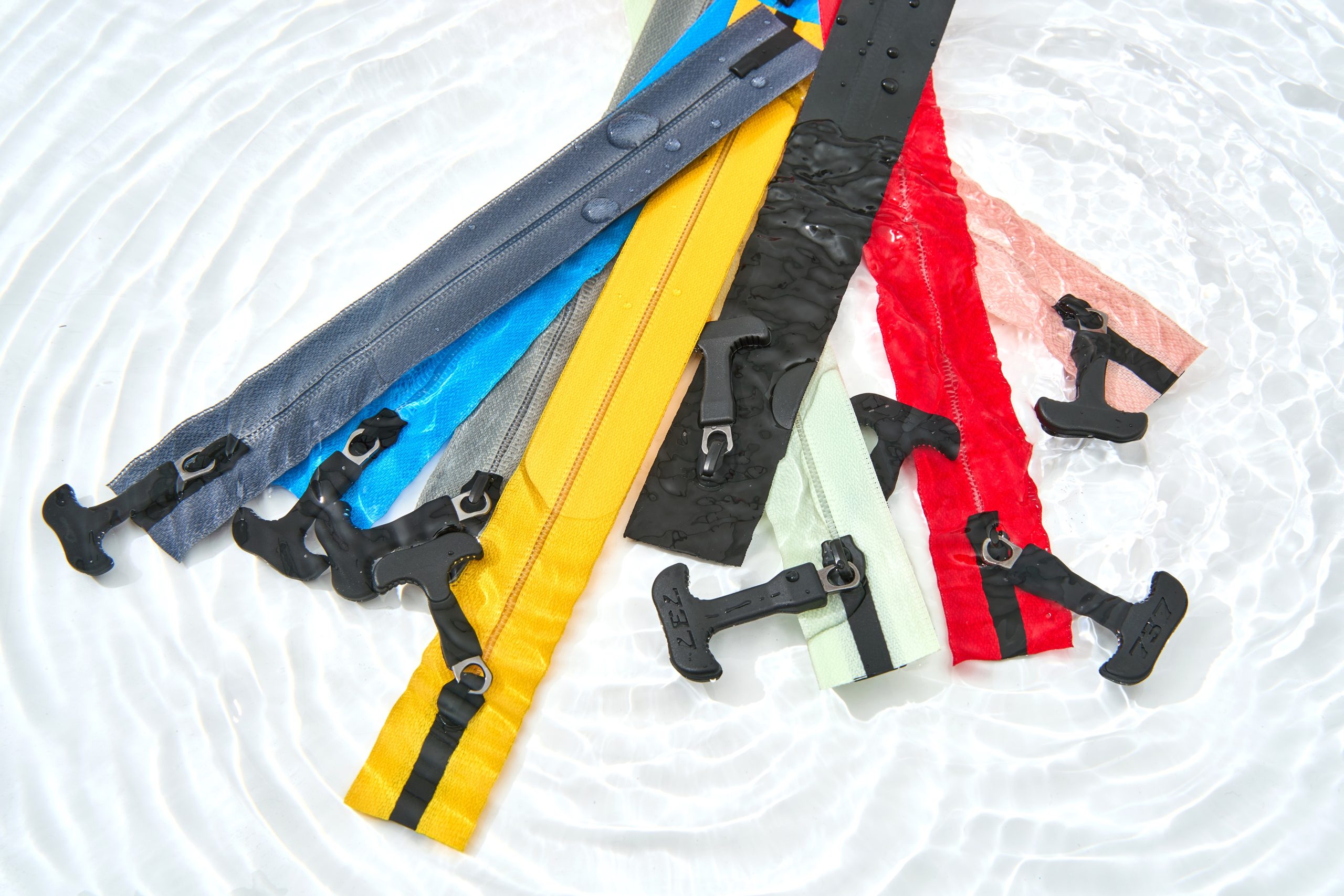
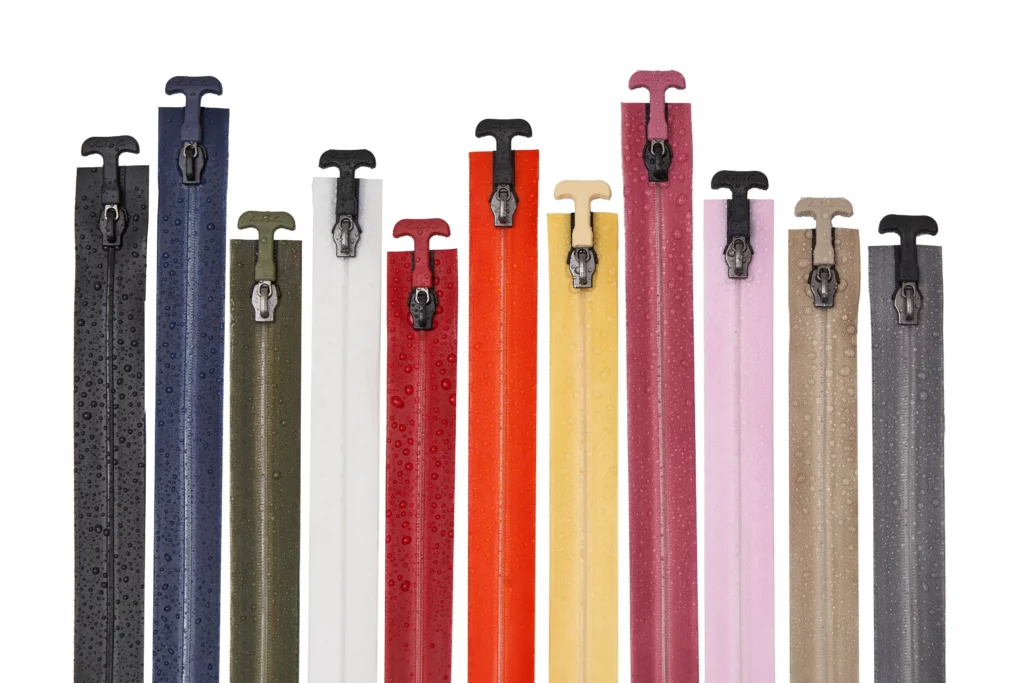
Hermetic zipper assemblies rely on a few interacting parts: a coated tape laminated to a textile substrate; interlocking elements with sealing lips; sliders that compress the seal uniformly; and end stops or blocks that complete the barrier. That barrier is only as good as its weakest interface—often the tape-to-fabric bond or the slider’s ability to maintain alignment under load.
Common failure modes in chlorinated-pool contexts include adhesive or weld delamination after repeated bending, compression set in sealing profiles, particulate contamination that scuffs sealing lips, and corrosion that increases slider friction until alignment falters. Chloride-rich environments can attack metals—some stainless grades resist better than others—and once friction rises, users tend to tug harder, amplifying wear.
If you need a neutral, technical overview of hermetic zipper families used in medical isolation, HAZMAT, and diving contexts—not as an endorsement for water walking balls—see the background descriptions at ZIZIP. Use such resources to understand architectures and terminology before specifying test plans.
Repeatable airtightness test protocol — step by step
The following protocol helps engineering teams produce auditable, apples-to-apples data on zipper–panel assemblies. It borrows instrumentation ideas from ASTM F2096 and material characterization from ASTM D751 and ISO 1421. Use it to benchmark alternatives and to understand drift after pool-relevant stressors.
Scope and specimens
- Build at least three zipper–fabric assemblies per configuration, using production-intent bonding methods. Label and log each specimen’s build parameters.
Preconditioning
- Set A: Baseline, no conditioning.
- Set B: Chlorine soak at 200 ppm, pH 7.2–7.6, 25–30°C for 72 hours; fresh-water rinse and dry 24 hours.
- Set C: 1,000 slider actuations with force logging at 100-cycle intervals.
Leak measurement
- Pressurize to 3.0 kPa internal gauge; stabilize for 5 minutes.
- Record either: (a) mass flow needed to hold 3.0 kPa over 30 minutes in mL per minute; or (b) pressure decay curve and infer leakage using the known internal volume.
- For bubble visualization, follow the principles of ASTM F2096 bubble leak testing: constant depth, quiescent water, and photographic documentation of leak points.
Material and bond checks
- Use ASTM D751 for coated fabrics to assess hydrostatic resistance trends of coated tapes or panels pre- and post-conditioning.
- Use ISO 1421 tensile testing of coated fabrics on coupons cut near the zipper–tape interface to track strength retention.
Reporting and acceptance framing
- Report kPa × minutes, raw leak rates, confidence intervals across specimens, and any visual leak maps. Instead of hard universal pass–fail lines—especially given the CPSC prohibition—frame results as comparative data to inform engineering judgment.
Example data table — demonstration values
Below is an illustrative format showing how results might be presented. Values are for demonstration only to show units and structure.
| Specimen | Conditioning | Pressure kPa | Hold min | Leak rate mL/min | kPa × min | Notes |
|---|---|---|---|---|---|---|
| A-1 | Baseline | 3.0 | 30 | 2.1 | 90 | No visible bubbles |
| A-2 | Chlorine 200 ppm 72 h | 3.0 | 30 | 3.4 | 90 | Minor slider roughness |
| A-3 | 1,000 cycles | 3.0 | 30 | 3.0 | 90 | Force 12–14 N |
Zipper selection and material compatibility — what to prioritize
- Sealing geometry and redundancy: Favor architectures that maintain uniform compression under load and offer redundant barriers. Redundancy can prevent single-point failures at end stops or lips from becoming gross leaks.
- TPU chemistry choices: Polyether-based TPUs generally resist hydrolysis better than polyester-based grades in warm, wet conditions. Materials literature from polymer producers documents this difference and explains why long-term humidity and chlorine exposure accelerate degradation in polyester-based TPUs. For an accessible technical overview, see BASF’s Elastollan note on chemical properties and hydrolysis resistance: BASF technical note on TPU chemical properties.
- Corrosion resistance in slider and elements: Chloride-rich environments can pit or stain steels and corrode copper alloys. An open-access study on sodium hypochlorite solutions compares corrosion behavior across steel grades and is a useful reference when selecting metals or coatings for slider assemblies: Study of chlorine influence on steel corrosion in hypochlorite. Build in freshwater rinse-and-dry steps after exposure to pool water.
- Adhesion and weld integrity: Validate tape-to-fabric bonds after chlorine exposure with standardized peel or adhesion tests derived from ASTM D751, and confirm no loss of integrity at end stops or corner radii.
Operator practices and rescue accessibility — principles to carry forward
If your work touches inflatable amusements in aquatic settings, build around supervision, documentation, and emergency access. The UK Health and Safety Executive outlines operator responsibilities for sealed and water-based inflatables, emphasizing trained supervision, equipment checks, and documentation—useful as general safety principles rather than water-ball endorsements. See the HSE’s overview of operator responsibilities for sealed inflatables: HSE guidance for sealed inflatables and operator responsibilities.
National lifesaving organizations provide additional framing for pool versus open-water risks. The Royal Life Saving Society Australia, for example, publishes inflatable safety alerts that stress supervision models and alignment with relevant standards for inflatable play equipment. Review their alert for broad operational considerations: RLSSA inflatable safety alert.
Across all of these sources, one throughline holds: external access for quick opening, proximity of trained operators, and clear rescue drills. Even in non–water-ball contexts, if a sealed enclosure depends on an externally operated zipper, your design must assume rapid external intervention.
Inspection, maintenance, and retirement — practical thresholds
Rather than rely on a single pass or fail, track trends and trigger retirements based on drift from baseline:
- Pre-use checks: Log slider operation force, look for coating cracks at bends, and inspect end stops and corner radii where leaks often begin. Run a quick 1.5 kPa, 10-minute pressure-hold and record percent pressure loss per hour.
- Post-exposure care: After chlorinated-water use or testing, rinse with fresh water and dry thoroughly. Lightly lubricate sliders with a TPU-compatible product if specified by the manufacturer, then cycle a few times to distribute.
- Retirement markers: Repeated leak points at identical locations, a sustained leak-rate increase beyond your program threshold, visible delamination, or slider seizure that doesn’t resolve after cleaning. Keep photographic evidence and link each retirement to logged test data.
Glossary and sources — quick reference
- Airtightness: Degree to which an assembly prevents gas leakage. Report as mL per minute or sccm at a defined pressure, plus the kPa × minutes context for hold tests.
- kPa × minutes: Scalar of pressure and duration at setpoint. Helpful for comparing equal-pressure holds of different durations.
- Bubble leak mapping: Visual method inspired by ASTM F2096 to locate and categorize leak sites during submerged pressurization.
- Coated fabric tensile: ISO 1421 strip tests for strength and elongation of coated fabrics near zipper bonds.
Primary sources and further reading:
- CPSC prohibition framing and hazards: CPSC Consumer Alert — water walking balls
- Leak detection method and scope: ASTM F2096 bubble leak test
- Coated fabric method suite: ASTM D751 coated fabrics
- Coated fabric tensile basics: ISO 1421 index for coated fabrics
- Pool chemistry operating ranges: CDC operating guidance for public pools
- Operator principles for sealed inflatables: HSE guidance for sealed inflatables and operator responsibilities
- Inflatable safety framing in aquatic venues: RLSSA inflatable safety alert
- Corrosion context in chlorinated environments: Hypochlorite corrosion study on steels
A final word: water walking ball zipper specifications can help you characterize a closure, compare materials, and document wear. They cannot eliminate the inherent hazards documented by regulators. If your organization touches this category, start with the prohibition, seek local authority guidance, and keep engineering metrics transparent and auditable for any sealed-inflatable work you do elsewhere.