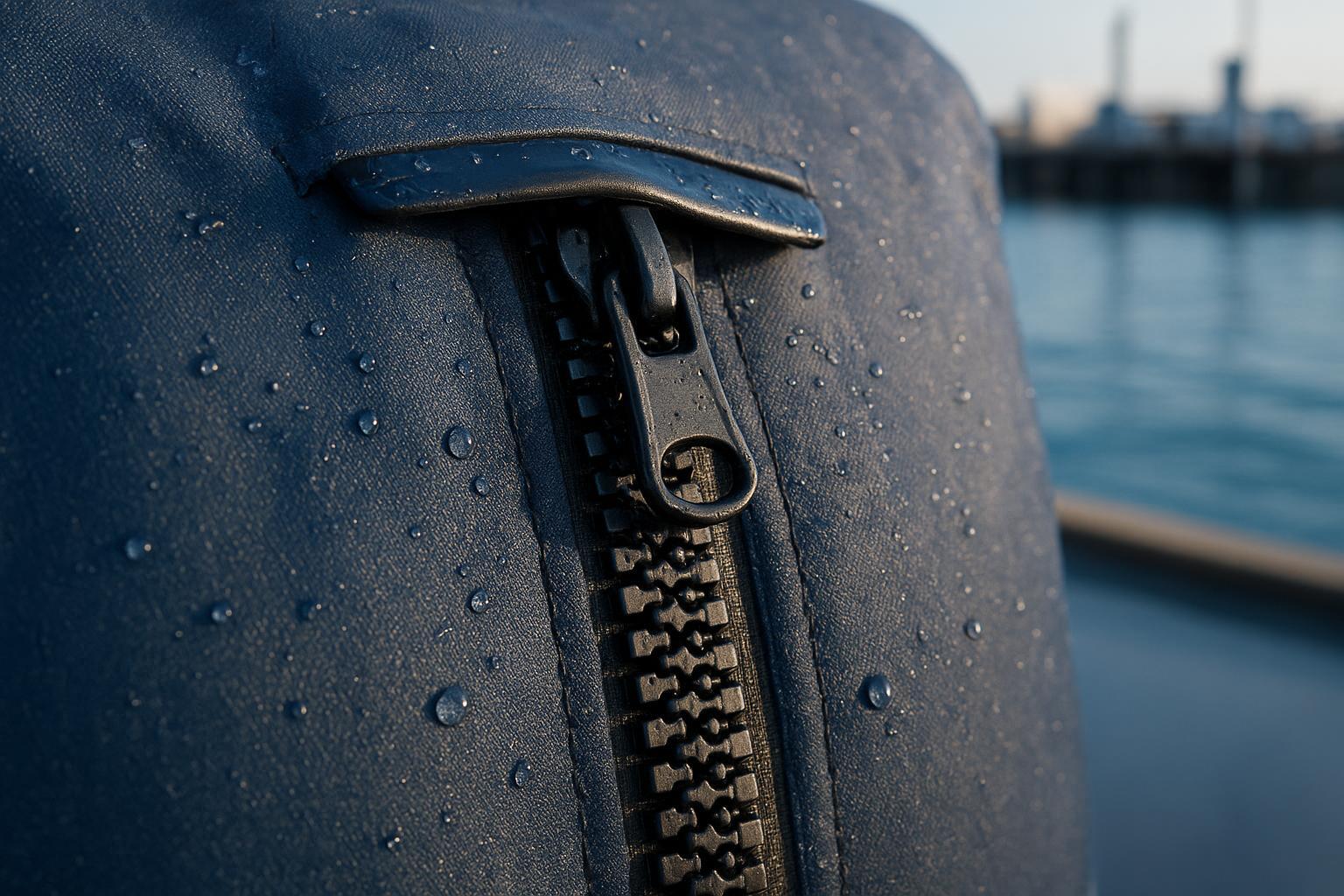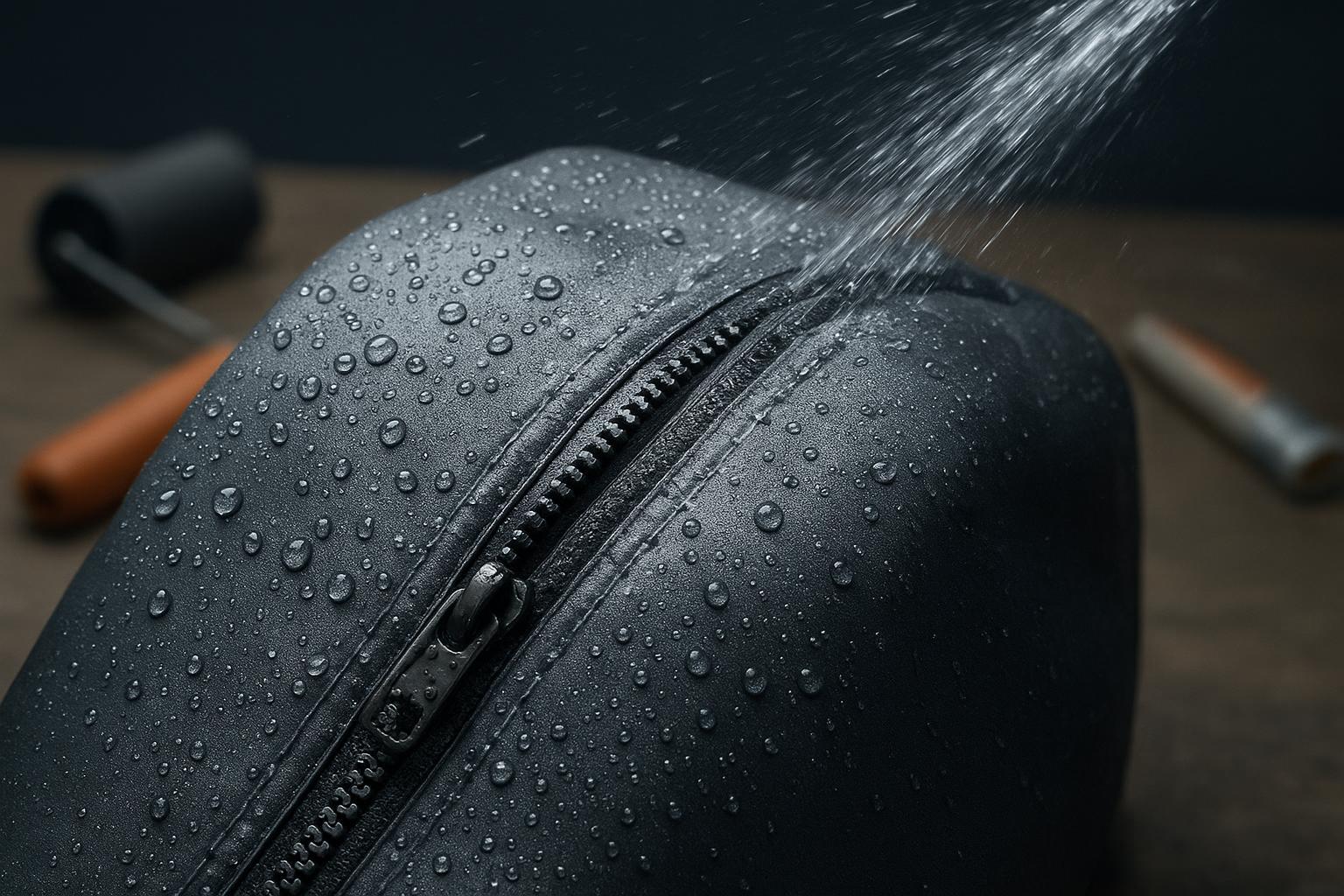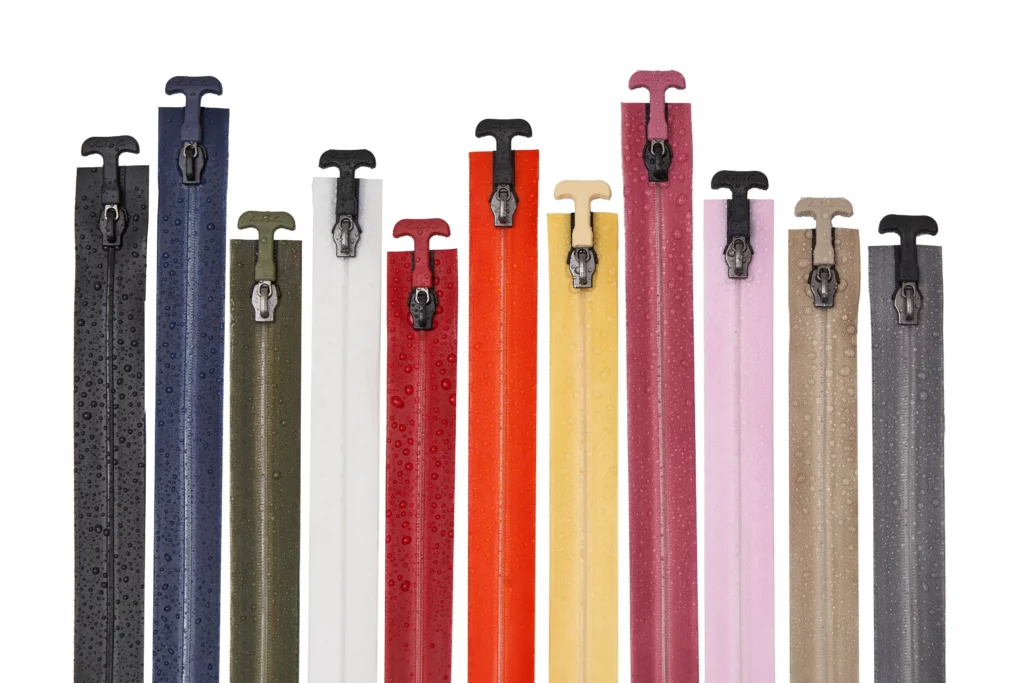
Designing zipper closures that stay sealed around dry ice, survive repeated condensation, and pass aerospace contamination controls is a multidisciplinary job. This guide shows how to build and qualify assemblies that meet low-outgassing screening per ASTM E595 with NASA and ECSS practices, achieve IPX7–IPX8 immersion performance, and pass an OEM reliability package that stands up in audit. Throughout, we’ll keep the focus on airtight zippers for cryogenic applications and how to translate standards into testable requirements.
Before we begin, a few definitions used throughout:
- TML: Total Mass Loss under ASTM E595 (% of mass lost during high-vacuum, high-temperature exposure)
- CVCM: Collected Volatile Condensable Material (% condensables collected on a cold plate)
- WVR: Water Vapor Regained (% reabsorbed moisture after conditioning)
- RML: Remaining Mass Loss = TML − WVR
- IPX7/IPX8: Water ingress protection levels per IEC 60529; they do not measure gas leak tightness
- Leak-rate units: mbar·L/s, sccm, or atm·cc/s for gas leakage; unrelated to IPX ratings
Key takeaways
- Use ASTM E595 as the screening backbone and select nonmetallics that meet NASA thresholds; apply ECSS where required for ESA programs.
- Treat IPX7–IPX8 as water ingress ratings and verify gas tightness with deterministic pressure or vacuum decay; do not equate IP with hermeticity.
- Design for −78.5°C dry-ice handling with condensation cycles: screen materials with TPU low-temperature flexibility tests and integrate environmental cycling.
- Build an OEM qualification and reliability package: type tests, thermal shock, seal fatigue, hydrostatic immersion, pressure/vacuum decay, and HALT/HASS where appropriate.
- Document everything: DVP&R, calibration, MSA for leak fixtures, outgassing traceability, and clear IPX8 depth/time declarations.
The compliance spine: ASTM E595 with NASA and ECSS practice
ASTM E595 quantifies how materials outgas in vacuum at elevated temperature. It measures TML, CVCM, and WVR over 24 hours at roughly 125°C under high vacuum. The method itself does not set pass/fail; programs do. In aerospace, many programs adopt NASA screening guidance: CVCM ≤ 0.10% and either TML ≤ 1.0% or a conditional pass when TML − WVR ≤ 1.0% if the CVCM criterion is met, as summarized by NASA and the Goddard database. According to the NASA Goddard team’s documentation, engineers should screen candidate polymers and adhesives against database entries and check processing notes in the user guide.
European programs often apply ECSS-Q-ST-70-02C, which uses RML = TML − WVR, with typical acceptance of RML < 1.0% and a stricter CVCM < 0.01%. That stricter condensable limit can drive adhesive and coating choices. When you compile your bill of materials for zipper tapes, coatings, adhesives, and sealants, screen each nonmetallic against these thresholds. For selection and record-keeping, consult the ECSS Materials and Processes volume.
Helpful references:
- NASA screening criteria and materials selection workflow are detailed in the Goddard resources: see the descriptive overview in the NASA GSFC Outgassing Database user guide and the searchable NASA GSFC Outgassing Database.
- ECSS practice and materials/process assurance appear in the ECSS Q‑ST‑70 Materials and Processes volume.
IPX7 vs IPX8 for airtight zippers—and why gas tightness needs different tests
IEC 60529 defines immersion tests for water ingress protection. IPX7 verifies temporary immersion at 1 m for 30 minutes. IPX8 covers continuous immersion beyond 1 m, but depth and duration are defined by agreement and must be stated in reports. Accredited labs and certifiers explain this distinction consistently; for instance, Keystone’s overview clarifies the fixed IPX7 condition and negotiated IPX8 parameters. See the Keystone Compliance IPX7/IPX8 immersion summary.
Here’s the deal: IPX ratings are about water ingress under hydrostatic pressure. Gas leak tightness is different physics and needs deterministic methods like pressure or vacuum decay (or helium mass spectrometry when contractually required). Specify IPX targets for immersion resilience, then add gas leakage acceptance separately in your DVP&R. If you want a quick sanity check term to appear in your spec, include “IPX7 IPX8 zipper test” as an immersion line item and “pressure decay test zipper” as your gas-tightness method.
For planning immersion:
- Use IPX7 as a baseline for incident immersion.
- Define IPX8 explicitly: for example, 3 m for 2 hours at 23°C water, with pre- and post-functional checks.
General IP guidance is also covered on the Keystone IEC 60529 page, which emphasizes declaring IPX8 conditions.
Designing for dry ice and condensation cycling at −78.5°C
Dry-ice handling is harsh on polymers and coated fabrics. You’re dealing with glass-transition proximity, stiffness spikes, embrittlement risk, and repeated wetting as assemblies warm up. Since no single public standard defines a complete “dry-ice with condensation” cycle, tailor from proven environmental methods.
A practical approach for airtight zippers for cryogenic applications:
- Screen material stacks first. Use low-temperature flexibility tests such as ASTM D2136 (bend flexibility of coated fabrics) and ASTM D2137 (brittleness point of flexible polymers). Favor TPU formulations and adhesives with proven flexibility near −80°C.
- Build an environmental cycling profile. Combine cold soaks at −78.5°C (2–4 h per cycle) with warm, high-humidity dwells (e.g., 25–40°C at 85–95% RH) to force condensate. Control ramp rates to limit mechanical shock.
- Add functional checks within the cycle. After selected cycles, run immersion at IPX7 or your specified IPX8 and perform pressure or vacuum decay on a stabilized fixture before resuming cycling.
Standards scaffolding to cite and tailor from includes MIL-STD-810H Method 502 for low temperature, Method 503 for temperature shock, and Method 507 for humidity cycling. A practical public overview of temperature shock is available in the MIL‑STD‑810H Method 503.7 excerpt.
Materials and adhesives that pass outgassing and the cold
Selecting the right stack is half the battle.
What to look for:
- TPU-coated tapes and substrates with low-outgassing records per the NASA database and with favorable TPU low-temperature flexibility results (ASTM D2136/D2137).
- Adhesives and primers with documented E595 results; prefer systems with low CVCM and, for ESA work, those meeting RML < 1.0% and CVCM < 0.01% under ECSS.
- Sliders and hardware with corrosion resistance appropriate to condensation and washdown exposure.
Documentation to demand:
- Outgassing reports listing TML, CVCM, and WVR with specimen preparation notes and cure schedules.
- Low-temperature flexibility test results (mandrel size and pass/fail) and brittleness points.
- Bond-line data: peel strength and shear at ambient and cold conditions, plus evidence of no adhesive creep after cold soaks and condensate exposure.
If an otherwise ideal adhesive narrowly misses a CVCM threshold, evaluate whether vacuum bake or alternative cure schedules (as recognized in NASA implementation notes) can achieve conditional acceptance with documented rationale.
Test methods and fixtures that stand up in audit
Deterministic gas-leak methods
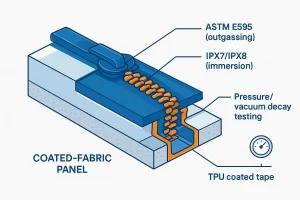
- Pressure or vacuum decay: Adapt ASTM-style deterministic methods for flexible packages to zipper-in-panel assemblies. Stabilize temperature, measure internal cavity volume, and log pressure change versus time. Convert results to mbar·L/s using Q = (ΔP · V)/t. Calibrate transducers and perform MSA on the fixture. For a sensitivity comparison of approaches, see Leybold’s engineer-focused explainer, Leak detection in pressurised devices—the sensitive test.
- Helium mass spectrometry: Use only when your contract calls for ultra-low leakage limits. It requires purpose-built fixtures and calibrated standards but can resolve far below 10⁻⁶ mbar·L/s in chamber mode. The ESS Vacuum Handbook, Part 4 outlines calibration references.
Hydrostatic immersion for water ingress
- IPX7: 1 m for 30 minutes at controlled water temperature with pre- and post-checks.
- IPX8: Declare the agreed depth and time in your test plan and on certificates. Use pressure vessels for deeper testing. Keystone’s overview on IEC 60529 explains declaration practices.
Gross-leak screening
- Bubble emission under vacuum is useful to find large, local defects before fine testing. It is destructive and operator-dependent, so rely on it only as a rough screen. See the test-lab summary of ASTM D3078 bubble emission.
Visual schematic: pressure-decay fixture
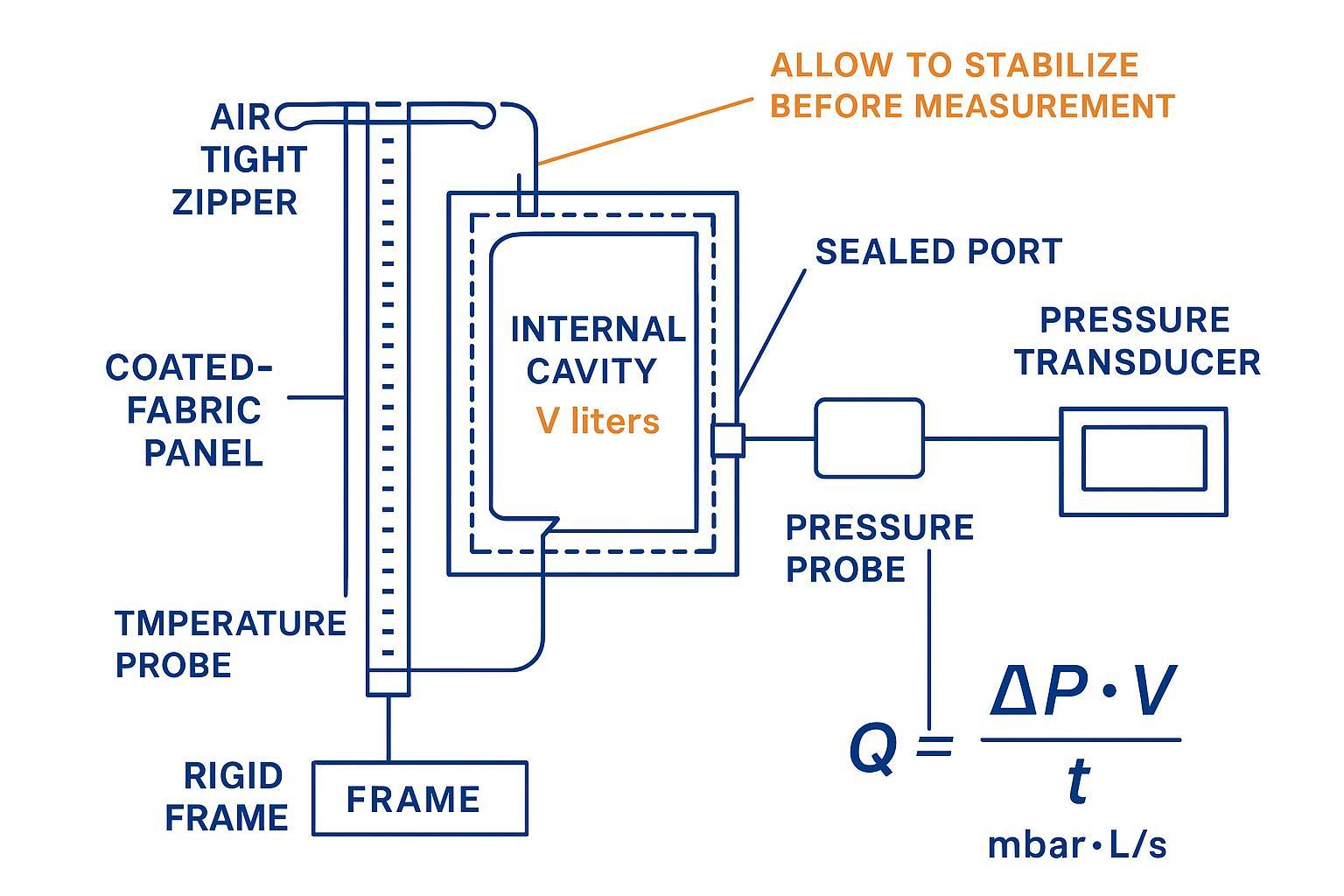
Worked conversion example
- Suppose ΔP = 25 mbar over 900 s with a 6.0 L fixture volume at stable temperature. Then Q = (25 × 6.0) / 900 = 0.1667 mbar·L/s. State temperature and uncertainty, and, if needed, convert to sccm using standard calculators.
Building the OEM qualification and reliability package
An auditable package bridges prototype and production and reduces surprises in PPAP/APQP-style launches—even when the governing framework is aerospace.
Recommended components:
- Type tests: transverse tensile of the zipper-in-panel, tape-to-substrate peel, slider pull force, reciprocation under load, hydrostatic immersion, and airtightness by pressure/vacuum decay. Include cold soaks at −78.5°C within the program.
- Reliability stresses: thermal shock cycles, humidity-driven condensation, seal fatigue cycles at cold, abrasion/contamination exposure relevant to the field.
- HALT/HASS: Use HALT early to discover dominant failure modes and derive a practical HASS screen for production. For fundamentals and terminology, see TT Electronics’ summary of HALT vs. HASS.
- Statistical controls: establish acceptance criteria with SPC. For variables data, target Cpk ≥ 1.33 once the process is locked. Record calibration intervals and MSA for leak fixtures and gauges.
- Documentation set: DVP&R, control plan, traceability of materials used in outgassing tests, calibration certificates, IPX8 declarations with depth/time, and environmental chamber logs.
A practical workflow example for a cryogenic transport panel
Below is a neutral, replicable workflow you can adapt for zipper-in-panel assemblies destined for medical or ground cryogenic transport. It keeps the focus on airtight zippers for cryogenic applications while separating water ingress (IPX) from gas leakage tests.
- Material screening and BOM freeze
- Use the NASA GSFC database to shortlist low-outgassing TPU tapes, coatings, and adhesives. Confirm TPU low-temperature flexibility via D2136/D2137.
- Fixture design and MSA
- Build a rigid clamp frame for the zipper-in-panel with an internal port, transducer, and logger. Determine internal volume precisely and run a gage R&R.
- Baseline integrity
- At ambient, perform pressure or vacuum decay after temperature stabilization. Record Q in mbar·L/s and document acceptance logic tied to the program requirement.
- Environmental cycling
- Run 10–30 cycles: −78.5°C soak for 2–4 h, then 25–40°C at 85–95% RH for 2–4 h to force condensate. Control ramps; avoid direct dry-ice contact.
- Immersion checks
- After selected cycles, conduct IPX7 immersion; if relevant to cleaning or immersion incidents, run a declared IPX8 condition. State depth/time in the protocol and report.
- Post-cycle integrity and seal fatigue
- Repeat pressure or vacuum decay at ambient. Add reciprocation cycles at cold with periodic integrity checks to map seal fatigue onset.
- Documentation and sign-off
- Compile DVP&R, calibration/MSA artifacts, profiles, acceptance decisions, and deviations. This packet supports QA and customer review.
Where a concrete product example helps learning, engineers sometimes test zipper architectures similar to those described in the AeroSeal family. For context on such architectures, see the Airtight zippers overview and the AeroSeal Dual-Track page as a model reference for an airtight zipper mechanism used in fabric panels. When waterproof trade-offs and washdown behavior matter, compare with the Waterproof zippers overview to align IPX expectations and sealing mechanics. These links are provided for architectural context; performance figures should be validated in your own program or via third-party certificates.
Troubleshooting and failure analysis
- Stiffness and cracking at cold: If bend failures occur or sliders bind after cold soaks, revisit TPU grade, plasticizer content, and tape construction; add larger bend radii in the design.
- Adhesive creep or delamination after condensate exposure: Increase surface preparation rigor, switch to primers with proven low CVCM, and re-qualify peel strength at cold and wet states.
- Sporadic leak spikes in decay tests: Check fixture sealing, temperature drift, and transducer zero. Re-run MSA and add soak times to ensure isothermal conditions.
- IPX8 pass at shallow depth but failure at deeper tests: Confirm that declared IPX8 depth/time matches the field scenario; evaluate compressive sealing path, slider end-stops, and panel reinforcement.
- Outgassing near misses: Consider alternative cure schedules or vacuum bake where permitted by program materials standards; document the rationale and retest.
Acceptance criteria reference table
| Topic | Baseline criteria | Notes |
|---|---|---|
| Outgassing for aerospace | NASA-style screen: CVCM ≤ 0.10% and TML ≤ 1.0%, or conditional pass if TML − WVR ≤ 1.0% with CVCM ≤ 0.10% | Use the NASA GSFC database to verify specific materials and processing notes |
| Outgassing for ESA work | ECSS: RML < 1.0% and CVCM < 0.01% | Stricter condensables screening; check ECSS Q-ST-70 references |
| IPX7 ingress | 1 m for 30 minutes | Fixed by IEC 60529 immersion definition |
| IPX8 ingress | Depth/time beyond 1 m by agreement | Declare exact parameters in test plan and report |
| Leak detection | Deterministic pressure or vacuum decay | Convert to mbar·L/s; calibrate and run MSA on fixtures |
Next steps
If you need sample DVP&R templates, third-party IPX certificates, or fixture guidance for pressure or vacuum decay, contact your preferred vendor and request the documentation set. You can also explore solution overviews at ZIZIP and request test reports or sample fixtures to accelerate your own qualification.