When a garment promises waterproof protection, the zipper becomes a mission‑critical component. This checklist is built for R&D and quality teams working with TPU‑coated waterproof/airtight zipper systems, where color consistency, branded puller durability, and batch stability make or break the program. We anchor every checkpoint to practical methods and recognizable standards so you can set clear acceptance gates, reduce rework, and protect your margins.
Key takeaways
- Use CIEDE2000 under D65 as the color reference and verify under TL84 to catch metamerism; typical guidance: ΔE00 ≤ 1.0–1.5 within trim family, ≤ 2.0 across materials.
- Make logo puller and slider appearance retention the hero KPI: screen with ASTM B117 salt spray and confirm coating adhesion via ISO 2409 or ASTM D3359 before scale‑up.
- Verify color fastness where users touch and rub: ISO 105‑X12 (dry/wet) and ISO 105‑E04 (perspiration) with clear gray‑scale targets.
- Lock down batch consistency with AQL for attributes and Cpk for key dimensions and color difference; require COA and a PPAP‑like dossier from suppliers.
- Document TPU bonding windows (temperature/pressure/dwell), low‑temperature operability, and chemical exposure checks to avoid field surprises.
- Keep a per‑lot retain set and define shelf‑life for TPU components; tie requalification to storage excursions and process changes.
Color and appearance verification using CIEDE2000 under D65 and TL84
Color is the first thing users notice, yet it’s often managed loosely. Instrumental measurement with CIEDE2000 (ΔE00) tightens control while visual checks under standardized light validate what the human eye will see. Use a calibrated spectrophotometer and report Lab* and ΔE00 to the master standard under D65. Then check under TL84 to detect metamerism. As a reference, Datacolor explains why brands prefer ΔE00 and multi‑illuminant checks for perceptual accuracy, and why tolerances are brand‑defined rather than universal; see Datacolor’s expert primers on ΔE00 and tolerance setting.
Visual assessment should be performed in a compliant light booth with neutral gray surroundings aligned to ISO 3664/3668 practices; switch between D65 and TL84 to observe metamerism. Treat thresholds as common practice and then validate with your own MSA and visual panels: within‑trim ΔE00 ≤ 1.0–1.5 under D65, cross‑material ≤ 2.0 with acceptable TL84 visual match.
For fastness, test TPU‑coated tapes and any fabric tapes in high‑contact zones. ISO 105‑X12 evaluates rubbing (dry and wet), while ISO 105‑E04 evaluates perspiration; grade with gray scales (1–5 where 5 is best). Typical acceptance for performance outerwear is ≥ Grade 4 dry and ≥ Grade 3–4 wet for X12, and for E04, color change ≥ 4 with staining ≥ 3–4. For an accessible method summary, see Intertek’s colorfastness testing overview of ISO 105‑X12/E04.
| Checkpoint | Method | Typical acceptance guidance |
|---|---|---|
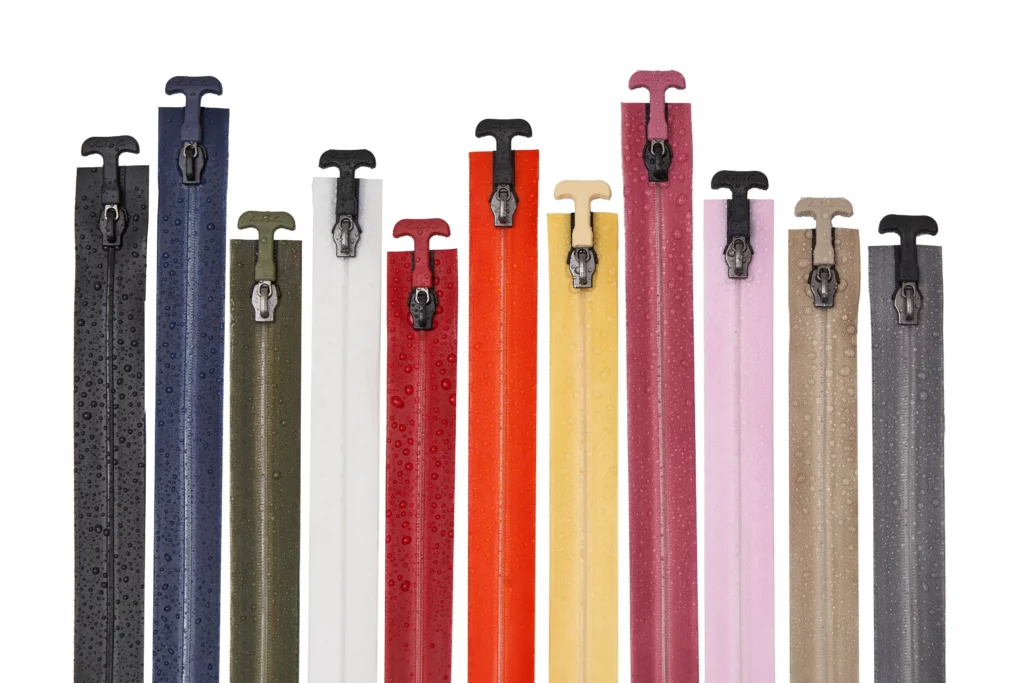
| Instrumental color match (TPU tape/film vs. master) | CIEDE2000 (ΔE00) under D65; confirm under TL84 | ΔE00 ≤ 1.0–1.5 within the trim family; ≤ 2.0 across materials |
| Visual color match | D65 and TL84 in a standardized booth | Acceptable visual match under both illuminants; document observer notes |
| Rubbing fastness | ISO 105‑X12, dry & wet | ≥ Grade 4 dry; ≥ Grade 3–4 wet |
| Perspiration fastness | ISO 105‑E04, acid/alkaline | Color change ≥ Grade 4; staining ≥ Grade 3–4 |
Tip: Think of D65 as the “clear daylight lens” for your numbers and TL84 as the “store light reality check.” If it passes both, you’ll avoid those jarring on‑rack mismatches.
Logo puller and slider branding durability as the primary KPI
Your logo puller is the most handled metal trim on the zipper—and often the first to discolor, corrode, or shed its finish. Make its durability the program’s hero KPI and gate supplier approval on it. Expose coated or plated pullers and sliders in neutral salt spray (5% NaCl, 35 °C, pH 6.5–7.2) per ASTM B117. Q‑Lab’s summary clarifies parameters and a crucial caveat: B117 is a comparative QC screen, not a field life predictor. Use buyer‑defined durations by environment profile (e.g., 24–48 h for general outdoor apparel; ≥ 96 h for marine/coastal). See Q‑Lab’s ASTM B117 practice overview and limitations.
Define acceptance language for appearance and function: “No red rust” on significant surfaces at the specified hour mark; no blistering or flaking; slider still opens/closes smoothly. Then verify coating adhesion via cross‑cut/cross‑hatch methods. Map ratings consistently: ISO 2409 Class 0 ≈ ASTM D3359 5B (best), Class 1 ≈ 4B (<5% removal). Typical acceptance is ISO 2409 Class 0–1 or ASTM D3359 ≥ 4B. For methods and scales, see DeFelsko’s adhesion testing overview.
Pro move: Document the exact acceptance language in your control plan, including surfaces examined, hour marks, photo angles, and the definition of “no red rust.” Ambiguity here drives avoidable disputes.
Batch‑to‑batch consistency and documentation controls
Even great samples can drift in production. Combine attribute sampling (AQL) with process capability (Cpk) and require evidence‑rich documentation so each lot is verifiably on target. Define Critical/Major/Minor defect classes for zipper systems (e.g., leaks or teeth/element defects as Critical; color deviation as Major; minor scuffs as Minor). Common apparel policies use AQLs around Critical 0.0–0.1%, Major 1.5–2.5%, Minor 4.0–6.5%. Quality Magazine provides a helpful overview of Z1.4 sampling; see Quality Magazine’s primer on ANSI/ASQ Z1.4 acceptance sampling.
For process capability, set Cpk ≥ 1.33 for critical dimensions (e.g., tape width, chain pitch) and for color difference vs. master (ΔE00). Elevate to ≥ 1.67 for high‑reliability programs. Require traceability (lot/date codes; sub‑supplier approvals) and requalify after storage excursions, formulation changes, or any process change that touches sealing, coating, or plating.
| Document or control | Required fields and notes |
|---|---|
| Certificate of Analysis (per lot) | Lot #, date, instrument calibration date; Lab* and ΔE00 (D65, TL84) vs. master; ISO 105‑X12 dry/wet grades; ISO 105‑E04 color change/staining; ASTM B117 hour mark and photos for pullers/sliders; adhesion rating (ISO 2409 class or ASTM D3359 grade) with cross‑hatch photo; tape width/chain pitch and pull‑force data; compliance (REACH/RoHS) |
| PPAP‑like dossier (trim adaptation) | Control plan; PFMEA‑style risk log for sealing steps; material specs; master/golden samples; gage R&R for spectrophotometer and force gauges; first article report; approved sub‑suppliers (plating, paint, TPU film); traceability schema; requalification triggers |
| Retains and shelf‑life rules | Keep a master standard set and per‑lot retains (tape swatch + slider/puller) for 12–24 months or program life; store at controlled temperature/RH; define TPU adhesive/tape shelf‑life (commonly ~12 months); log storage excursions and requalify as needed |
Integration and compatibility checks for TPU systems
Great lab numbers mean little if the zipper won’t bond, seal, or run smoothly in the field. Record press temperature, pressure, and dwell time for TPU tape bonding to your shell/backer. Use supplier advisories to pick starting points; for example, adhesive selector guides in the apparel space indicate typical flat‑press bonding temperatures on the order of 130–185 °C, but exact values depend on chemistry and build. See the reference ranges in the Bemis Sewfree Adhesives Selector Guide (2023) and then finalize your own validated window.
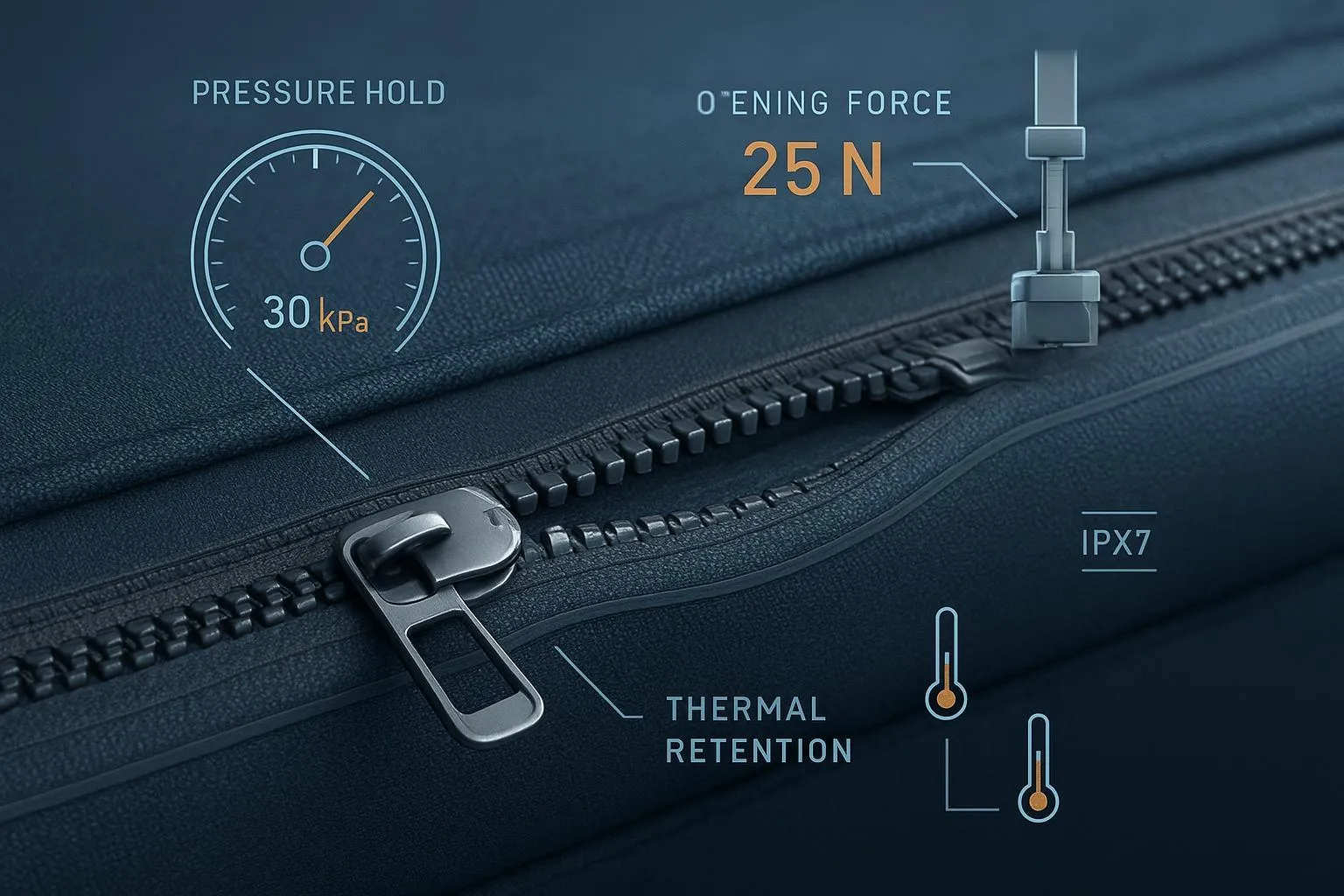
Check for whitening/softening under DEET, sunscreen, detergents, and sweat. Run cold‑soak/ice cycles and measure slider pull force vs. temperature; document “cold start” force so customer service isn’t surprised. If your shell uses printed logos or heat‑transfers near the zipper, verify appearance under TL84 because print inks can swing under store light and clash with TPU coatings. Curves, seam overlaps, and garages can make or break sealing performance and user feel; for design strategies specific to waterproof zipper paths, consult the guide to designing waterproof zipper paths in outdoor jackets. If you need IPX context for waterproof versus airtight targets, see Waterproof Zippers (IPX5 context) and Airtight Zippers (IPX7–IPX8 context).
Acceptance gates and sampling plan — your outdoor apparel zipper quality checklist in practice
Tie everything together with clear go/no‑go rules and a sampling plan scaled to risk. Set the gate for color: within‑trim ΔE00 ≤ 1.0–1.5 under D65 with acceptable TL84 visual match; cross‑material ≤ 2.0. Require ISO 105‑X12/E04 fastness grades at or above your specified levels in the acceptance table.
Gate the hero KPI: For logo pullers/sliders, pass ASTM B117 at the specified hour with no red rust and intact finish; pass adhesion at ISO 2409 Class 0–1 or ASTM D3359 ≥ 4B. Include before/after photos and an inspector sign‑off. Use Z1.4 to set sample sizes by lot volume and inspection level (often II for normal). Switch to tightened inspection for back‑to‑back rejects; reduce for sustained conformance. Finally, run gage R&R for the spectrophotometer and force gauges before locking ΔE00 and pull‑force gates. Without MSA, you can’t trust Cpk.
Question to sanity‑check your plan: If a field failure occurs, can you pull the lot’s COA, retains, and photo evidence within minutes—and would a third party agree with your acceptance decision?
Practical example for a jacket program
Disclosure: ZIZIP is our product.
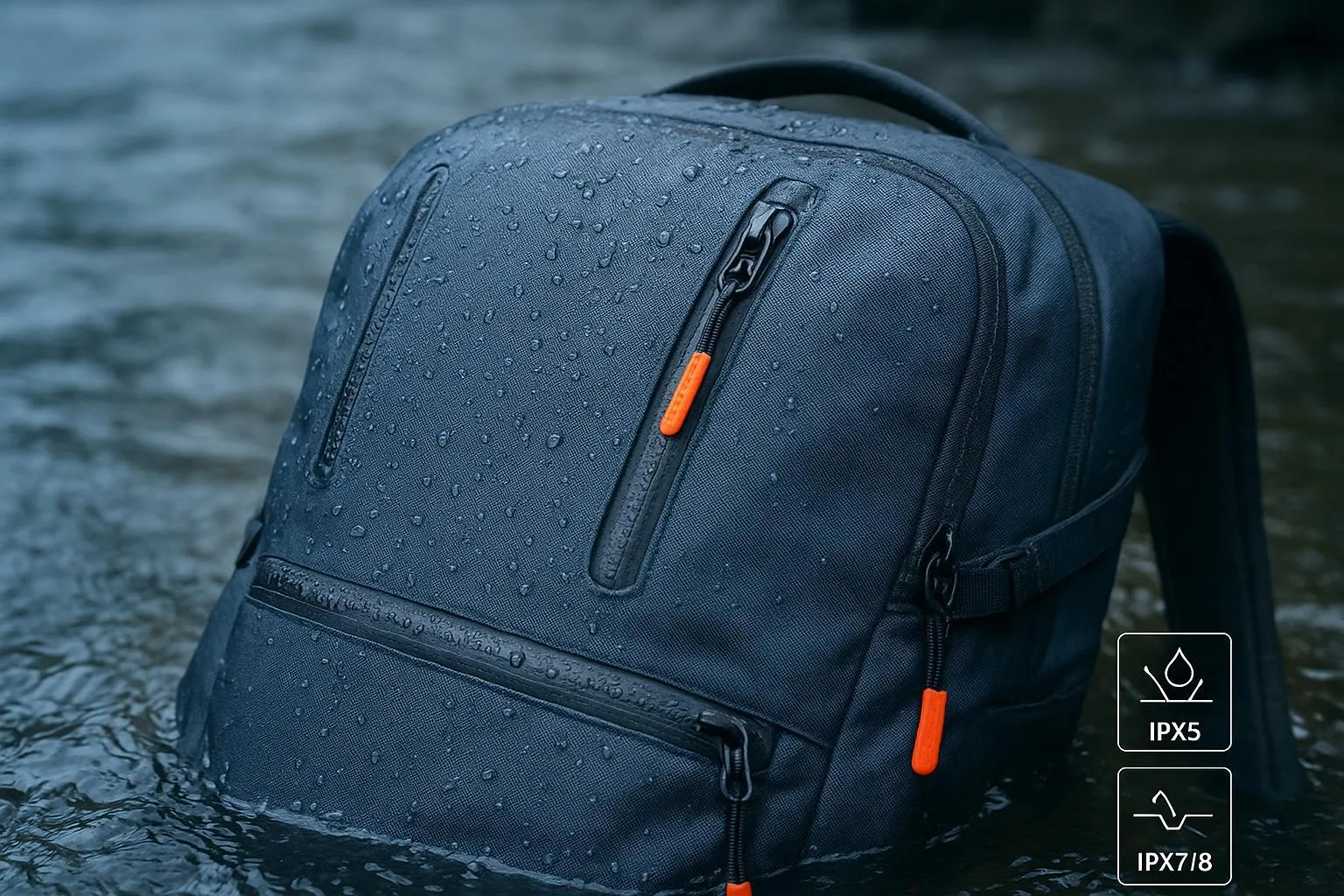
An outdoor shell program targets a waterproof zipper rated to IPX5 on the placket and an airtight system for a pocket used to protect electronics. The team defines color gates using ΔE00 under D65 and verifies under TL84 in a booth aligned to ISO 3664/3668 practices. They require ISO 105‑X12 dry ≥ 4 and wet ≥ 3–4 and ISO 105‑E04 color change ≥ 4/staining ≥ 3–4 on coated tapes. For logo pullers, they specify ASTM B117 48 h with no red rust and adhesion at ISO 2409 Class 0–1 or ASTM D3359 ≥ 4B. They document TPU bonding windows and low‑temperature force curves. For product context on IPX targets, they reference Waterproof Zippers with IPX5 context and Airtight Zippers with IPX7–IPX8 context.
Next steps
If this outdoor apparel zipper quality checklist aligns with your QA workflow, request data sheets, color standards, and a small sample kit from your preferred supplier to validate ΔE00, fastness, corrosion, and adhesion gates on your own equipment. If you work with ZIZIP, we can provide the same documentation set and retains guidance upon request.
Notes on sources for further reading:
- ΔE00 best practices and multi‑illuminant checks: Datacolor’s color management FAQs and tolerance guidance.
- ISO 105‑X12/E04 fastness overviews: Intertek’s colorfastness testing page.
- ASTM B117 parameters and limitations: Q‑Lab’s B117 standard page.
- Coating adhesion rating scales: DeFelsko’s adhesion testing overview.
- AQL acceptance sampling background: Quality Magazine’s overview of ANSI/ASQ Z1.4.
- Indicative TPU bonding temperature ranges: Bemis Sewfree Adhesives Selector Guide (2023).
SEO note: This resource aims to be your go‑to outdoor apparel zipper quality checklist for TPU‑coated waterproof and airtight systems—practical, testable, and ready to plug into supplier control plans.