Positive‑pressure isolation pods and hyperbaric chambers live or die by the integrity of their closures. When a zipper is the critical seal, the first decision isn’t just “will it hold pressure today?”—it’s “will it continue to seal after hundreds of cleanings and thousands of cycles?” This checklist centers on service life and maintainability under ΔP = 60–120 kPa with long, continuous pressurization (IPX8 immersion intent as complementary evidence), so teams can set measurable acceptance criteria and keep people safe.
Key takeaways
- Treat liquid ingress ratings (IPX7/IPX8) as complementary—not a substitute—for gas‑leak and pressure‑hold validation; document both with method, units, and dwell time.
- Make “post‑disinfection mechanical retention” a hard KPI: verify transverse tensile/peel ≥ X% after N cycles of NaOCl/VHP/70% IPA at defined concentrations and exposure modes.
- Standardize leak tests by ΔP bucket (60/90/120 kPa) using a pressure‑decay test and record acceptance in cc/min (sccm) or kPa·min with 30‑minute dwell at 23 °C.
- Design for maintainability: set inspection cadences (pre‑use/weekly/monthly), glide‑force windows, and clear replacement triggers tied to leak limits and strength loss.
- Document everything inside your QMS (ISO 13485) with risk analysis per ISO 14971; require supplier test reports and change‑control transparency.
Quick checklist (printable)
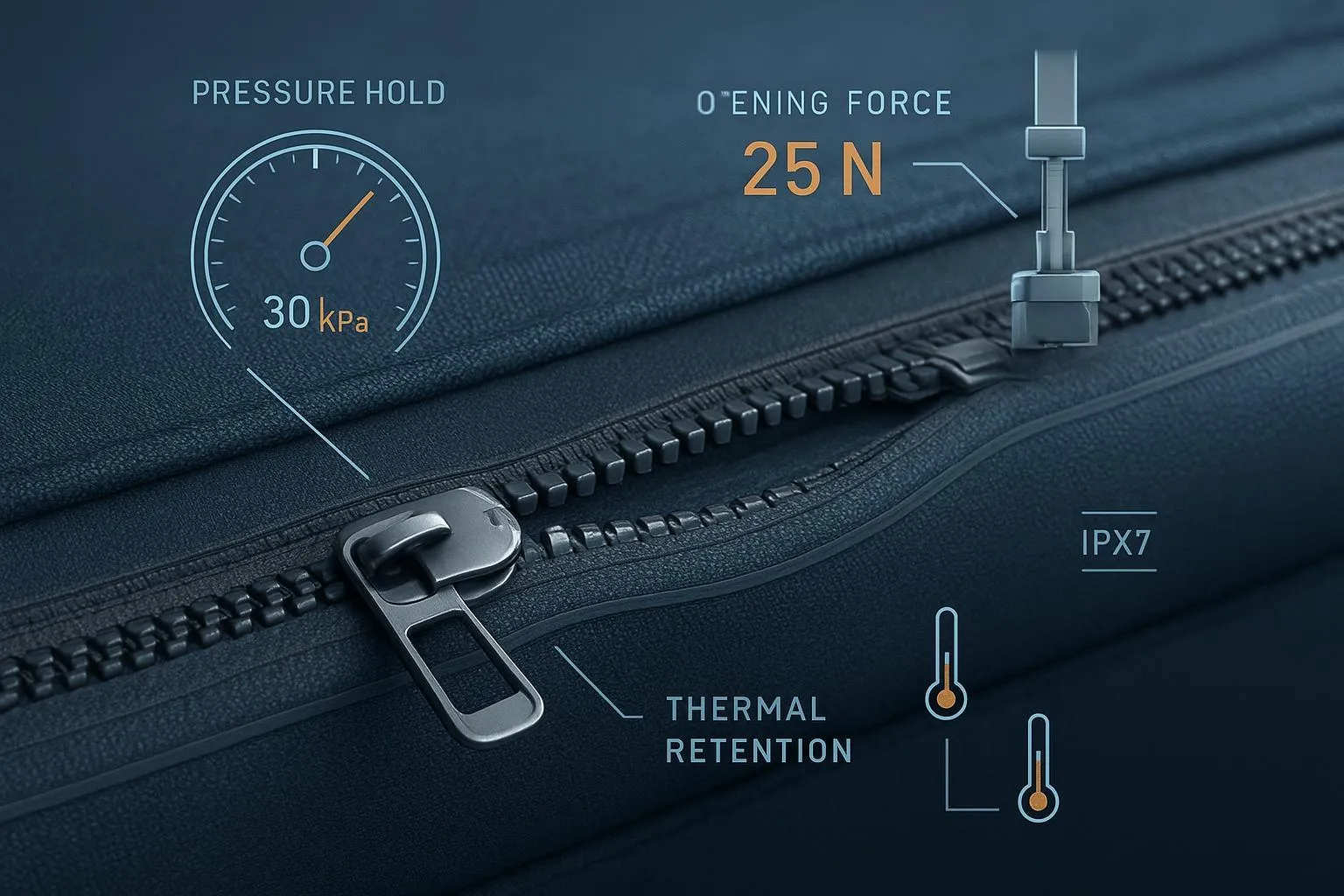
- Core acceptance (pressure & leak): Define ΔP targets (60/90/120 kPa). Select a pressure‑decay method (e.g., ASTM F2095 variant), set pass thresholds (e.g., ≤0.5 cc/min at 60 kPa; ≤1.0 cc/min at 120 kPa), 30‑min dwell at 23 °C. Record IPX class and method details for water ingress as complementary data; never equate IPX with gas‑tight performance.
- Disinfection & chemical compatibility: Specify NaOCl (ppm), VHP (mg/L or ppmv), and 70% IPA wipe cycles with exposure modes and dwell. Set retention KPI: transverse tensile/peel ≥ X% after N cycles; include appearance and glide criteria; define rinse/neutralization steps.
- Mechanical durability & lifecycle: Target ≥50,000 neutral‑pressure open/close cycles unless otherwise validated. Track glide‑force window, tooth/tape adhesion, bend/flex over −30 to +70–100 °C as materials allow. Confirm leak remains within limits.
- Installation & integration QA: Validate RF/heat‑weld seams with peel/shear (ASTM D903/D1876; D751). Respect curvature limits; reinforce end‑stops; define slider parking protocol; consider redundancy for higher ΔP.
- Inspection & maintenance: Pre‑use visual + functional sweep; weekly pressure‑hold spot check at representative ΔP; monthly seam‑coupon peel checks (if used). Replacement triggers: cracks/crazing, tackiness/delamination, glide force out of spec, or leak above limit.
- Documentation & compliance: Supplier datasheets, lab reports (methods, units, conditions), temperature range, chemical compatibility statements. Map controls to ISO 13485/14971 with change control.
Pressure & leak performance for airtight zippers for medical isolation chambers
For airtight zippers in medical isolation chambers, align pressure validation to your operating ΔP (60–120 kPa). Use a pressure‑decay method adapted to zipper assemblies (fixture with coated‑fabric panels, end‑stop caps, and in‑service slider position). Report method ID, gas (air), test volume and temperature (23 ±2 °C), dwell time, and acceptance thresholds.
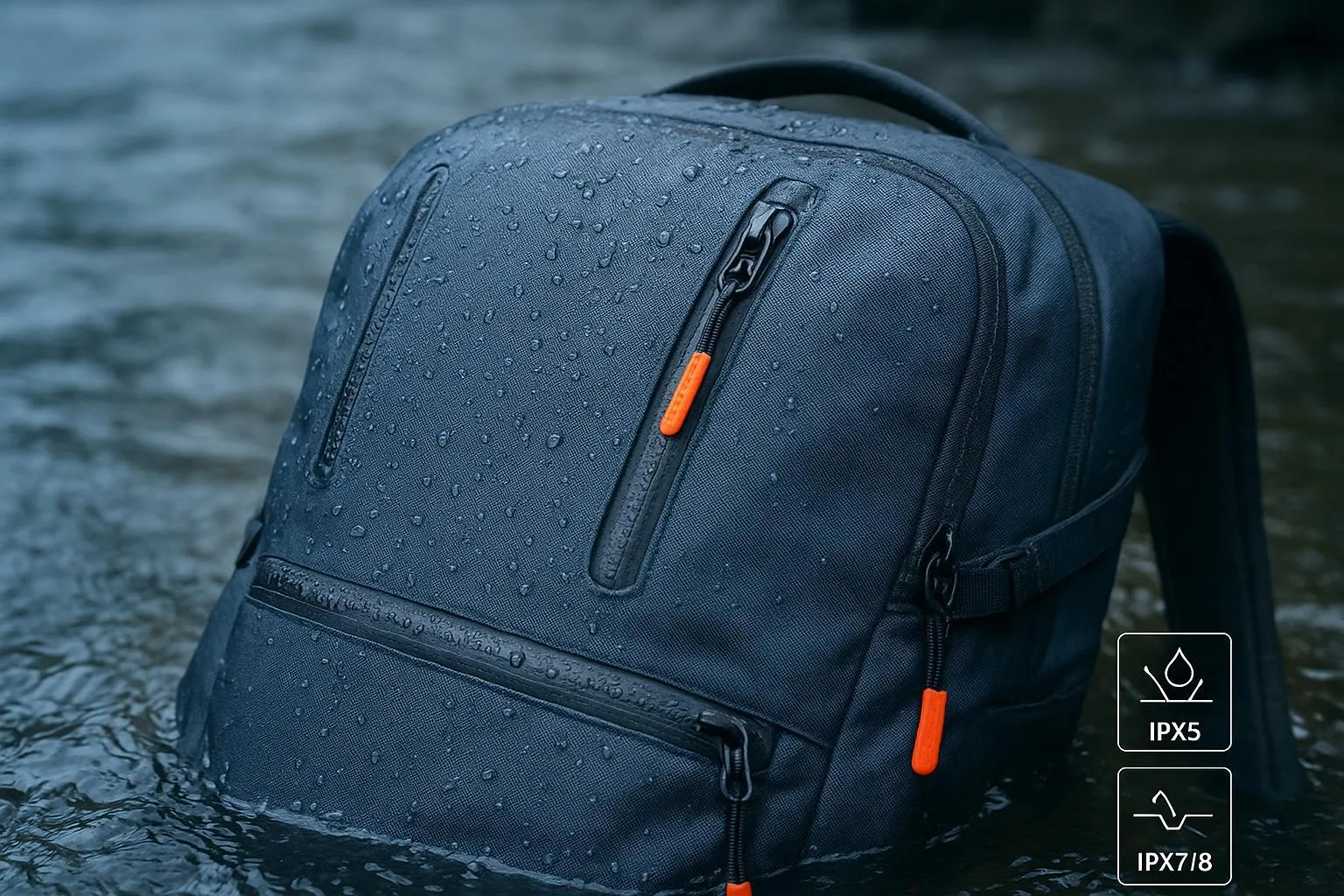
- Why IPX is not enough: IPX7/IPX8 per IEC 60529 addresses water ingress under immersion, not gas permeability. Treat it as complementary evidence only. See Intertek’s clear summary of IEC 60529 IPX7/IPX8 immersion scope (2025 overview). For context on how IPX relates to airtight applications, compare with this background on use cases in our airtight applications overview.
Example acceptance baselines to validate in your lab (engineering targets; confirm with supplier data and fixtures):
- ΔP = 60 kPa: ≤0.5 cc/min (sccm) average leak over 30 minutes at 23 °C
- ΔP = 120 kPa: ≤1.0 cc/min (sccm) average leak over 30 minutes at 23 °C
Tie numbers to an established framework such as ASTM F2095 pressure‑decay for flexible packages (method variant; document restraining plates and volume). For gross‑leak screening of subassemblies, a bubble test (ASTM F2096) is acceptable as a preliminary step; rely on quantitative pressure‑decay for acceptance.
Test methods at a glance
| Method | What it validates | Typical units | Notes |
|---|---|---|---|
| Pressure‑decay (ASTM F2095 variant) | Gas leak under ΔP in a flexible assembly | cc/min (sccm), or kPa·min | Primary quantitative acceptance; document volume and plates |
| Bubble leak (ASTM F2096) | Gross leaks under submersion | Visual (pass/fail) | Good screen; not an acceptance metric |
| Burst/creep (ASTM F2054 with plates) | Seal strength/early leak onset | kPa or psi | Reveals weak seams or track bonds |
| Vacuum decay (ASTM F2338) | Fine leak in rigid/nonporous | sccm‑equiv | Less common for flexible coated fabrics |
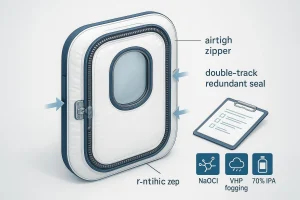
Redundancy for continuous pressurization: For hyperbaric duty or life‑critical transports, consider independent sealing paths so one closure can maintain hold if the other degrades. See a conceptual example of redundant tracks in this dual‑track sealing overview.
Disinfection & chemical compatibility
Define disinfectants, concentrations, exposure modes, dwell times, and cycle counts up front, then bind them to mechanical retention KPIs. For routine environmental services, the CDC cites sodium hypochlorite solutions around 500–615 ppm (1:100), with stronger 5,000–6,150 ppm (1:10) for blood spills; materials can degrade at higher strengths, so rinse promptly and prepare fresh solutions, per CDC environmental services guidance (accessed 2026).
- NaOCl (wipes/sprays): Track ppm and pH; implement rinse and, where SOPs allow, neutralize residue with dilute sodium thiosulfate before final DI rinse.
- VHP fogging: Specify dose (mg/L or ppmv), dwell, aeration to <1 ppm residual; polymers absorb VHP differently—expect to validate cumulative cycles for zipper tapes, seals, and sliders.
- Alcohols (70% IPA wipes): Monitor swelling/softening on seals and adhesives; set a maximum weekly cycle rate and check glide force afterward.
Lifecycle acceptance KPI (example engineering baselines to validate with your supplier):
- Transverse tensile/peel retention ≥90% after 50 VHP cycles
- ≥85% after 200 cycles of 70% IPA wipes
- ≥80% after 100 NaOCl wipes at 0.5%
These targets should be paired with post‑cycle leak tests at the operating ΔP and a visual/operability check (no cracking, tackiness, whitening/embrittlement, or out‑of‑spec glide force). Document the exact protocol, including cloth type for wipes, applied pressure, and dwell/aeration times.
Mechanical durability & lifecycle
Service life is the compound of three things: retained strength, operability, and leak performance. Establish a cycle‑life protocol that represents your duty profile.
- Open/close cycles: As a starting point for hyperbaric‑rated assemblies, use ≥50,000 neutral‑pressure cycles. If safe, add a pressure‑biased component to expose the slider and track to ΔP‑related loads during opening/closing.
- Strength retention suite: Use zipper strength methods from ASTM D2061 and seam/tape adhesion via ASTM D903 (peel) and D1876 (T‑peel), plus coated‑fabric seam checks in ASTM D751. Report in N or N/mm as appropriate, and compare to pre‑disinfection baselines.
- Temperature & flex: Validate glide force and seal integrity across the supplier’s range (often −30 °C to +70–100 °C). Look for tackiness, delamination, or hardening after cold soaks or heat dwells.
Acceptance should declare “pass” only when all three are true: retention meets target, glide force is within window, and leak stays at/below limit at the operating ΔP.
Materials & seal design considerations
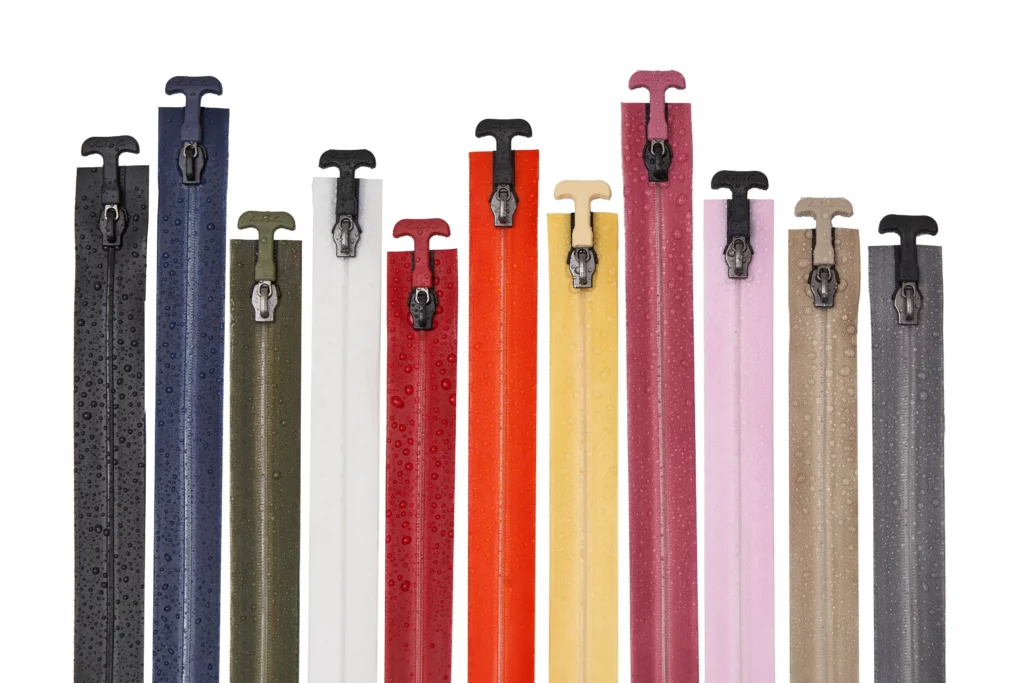
Disclosure: ZIZIP is our product. Where a TPU‑coated, airtight zipper is suitable for medical isolation or hyperbaric applications, rely on manufacturer‑stated IPX7 verification (with optional IPX8 conditions) as complementary data and require separate gas‑leak validation; ensure seal geometry and end‑stop protections match your ΔP and cleaning regimen.
Installation & integration QA
Durable performance starts at integration. Validate the join between zipper tape and coated fabrics and respect the geometry the track was engineered for.
- Bonding and seams: RF welding or heat‑sealing are typical. Validate seam coupons with ASTM D903/D1876 peel and D751 seam/hydrostatic where relevant. Record parameters (temperature, dwell, pressure, RF time/power) and establish acceptance bands.
- Curvature and alignment: Follow minimum bend radius for tracks; misalignment under curvature invites leak paths. Reinforce end‑stops; define slider parking so operators don’t leave partial seals.
- Redundancy & guards: For ΔP near the top of your range or where continuous pressurization is mission‑critical, add mechanical guards and consider redundant sealing paths (see dual‑track note above) to maintain hold through a single‑point degradation.
Inspection & maintenance program
Build a cadence your operators can execute—and your auditors can verify.
- Pre‑use (each operation): Visual sweep for cracks, crazing, tackiness, discoloration, or delamination; clear debris; run the slider full travel; confirm end‑stop integrity.
- Weekly: Spot pressure‑hold at a representative ΔP (e.g., 60 kPa for 10–30 minutes) via a small sealed test volume if safe; record leak in cc/min or kPa·min.
- Monthly: If your QMS uses witness coupons, pull a peel test against baseline (ASTM D903/D1876). Check glide force stays in the specified window; inspect slider tooth wear and tape adhesion.
- Post‑disinfection checkpoints: After every N cycles of NaOCl/VHP/IPA (define N), confirm transverse tensile/peel retention meets the KPI and repeat a leak test at your operating ΔP.
- Replacement triggers: Any visible crack/crazing; loss of peel/tensile beyond threshold; leak above limit at ΔP; persistent glide force out of window; end‑stop or track damage that cannot be corrected.
For typical care guidance and warranty limitations seen in the field, review a representative maintenance overview like this dual‑slider care and limitations note and adapt your SOPs accordingly.
Documentation & compliance
Treat the zipper assembly as a controlled component inside your device lifecycle.
- QMS mapping: Integrate acceptance criteria and verification steps into ISO 13485 processes; perform risk analysis per ISO 14971 for leak‑related hazards and misuse (e.g., partial closure, residue‑induced degradation).
- Evidence binder: Supplier datasheets with temperature range, tensile/peel data, and any ingress/pressure tests; lab reports for your fixtures and methods (pressure‑decay or equivalent), with units, dwell, and ΔP; disinfection cycling protocols and post‑cycle retention/leak results.
- Facility standards context: Hyperbaric operations fall under NFPA 99 and related guidance. Maintain procedures and logs consistent with the safety framework cited by NFPA and UHMS; see this NFPA 99 hyperbaric scope summary for the operating context and pressure ranges.
Short vendor questionnaire (use as part of RFQ)
- Please provide quantified gas‑leak data at ΔP = 60, 90, and 120 kPa using a named method (e.g., pressure‑decay), including units (cc/min or kPa·min), test volume, dwell time, and temperature.
- Provide post‑disinfection mechanical retention (transverse tensile/peel) after defined cycles of NaOCl (ppm and pH), VHP (dose and dwell/aeration), and 70% IPA wipes, plus any visual/operability findings.
- State operating temperature range and glide‑force window (new and post‑cycle), with the corresponding test methods.
- Document recommended welding/adhesion methods and seam parameters; include seam coupon test data (ASTM D903/D1876; D751 as applicable) and curvature limits.
- Describe maintenance limitations, cleaning agents to avoid, spare parts strategy (sliders/end‑stops), and replacement triggers honored under warranty.
References and method notes
- IP ingress testing context and scope for IPX7/IPX8 per IEC 60529: Intertek’s ingress protection overview (2025 summary).
- Pressure‑decay for flexible packages (method framework): ASTM F2095 (units and sensitivity notes).
- CDC disinfectant concentrations and cautions for environmental services: CDC environmental services guidance (accessed 2026; includes bleach ranges and material cautions).
- Hyperbaric safety/operating scope: NFPA 99 hyperbaric chapter documentation and UHMS scope summaries (cite within your facility manuals as applicable).
How to use this checklist
- Treat the numeric thresholds above as engineering baselines to validate—not procurement criteria—until supplier and lab data confirm they hold for your exact materials, welds, and fixtures. Once validated, lock them into your drawings, SOPs, and quality plans so service life and maintainability are built into day‑one acceptance and day‑N maintenance alike.