Removable protective covers live a hard life: constant flexing, dirt and salt, and frequent open–close cycles—often while still expected to pass IPX5 hose spray or occasional IPX7-style dips. This field guide distills practical, engineer-ready steps for specifying, maintaining, retrofitting, and—when needed—replacing waterproof zippers on TPU-coated fabrics.
Key takeaways
-
Choose zipper specs around frequent flex: TPU-coated tape, coil chain for tighter curves, appropriate gauge (#5 or #8), and reliable end seals.
-
Build a repeatable “waterproof zippers maintenance” routine with pre-use, weekly, and quarterly checks tied to quick hose/dip verification.
-
Use simple field tests: IPX5 hose spray and short IPX7-like dips, plus localized bubble checks, to confirm sealing after any service.
-
Decide retrofit vs. replace using visual cues (delamination, cracked film, stop damage) and test outcomes rather than guesswork.
Retrofit or replace — a quick decision matrix
|
Observable condition |
Quick test outcome |
Action |
Notes |
|---|---|---|---|
|
Debris, mild drag, no visible film damage |
Passes hose spray; no interior moisture |
Maintain/retrofit-light |
Clean and apply TPU-safe lube; document baseline slider feel |
|
Minor end-seal weep or stitch wicking |
Minor dampness near ends only |
Retrofit |
Reseal ends with seam tape or urethane adhesive; add/repair stops |
|
Film micro-cracks at bend or minor delamination |
Intermittent hose test fail |
Retrofit (monitor) |
Patch with TPU film/hot-melt; schedule earlier re-test |
|
Teeth/coil damage, deformed stops, slider slip/skip |
Repeated fail after cleaning/lube |
Replace |
Mechanical integrity compromised |
|
Broad laminate lift or long cracks along path |
Repeated fail and visible ingress |
Replace |
Risk of progressive failure under flex |
Waterproof zippers maintenance schedule for frequent-flex IPX5–7 covers
|
Cadence |
Tasks |
Replace/repair triggers |
|---|---|---|
|
Pre-use |
Remove debris; close–open once; spot-check with brief hose spray if recently serviced |
Persistent drag after cleaning; visible stop damage |
|
Weekly or ~200 cycles |
Rinse salt/dirt; dry; clean chain; verify slider operation; inspect bends for film cracks/ delamination; check end seals |
Cumulative visible cracks growing between checks; end seals lifting |
|
Quarterly or ~500–1,000 cycles |
Full IPX5 hose test; compare slider force/feel to baseline; inspect seam seals; document |
Repeat hose-test failures; leaks after reseal; structural tape tears |
Tip: Store covers unbent at the zipper line to reduce hinge-point fatigue, and keep a simple log of inspections and any “waterproof zippers maintenance” actions.
Quick leak verification: hose, dip, and bubble checks
-
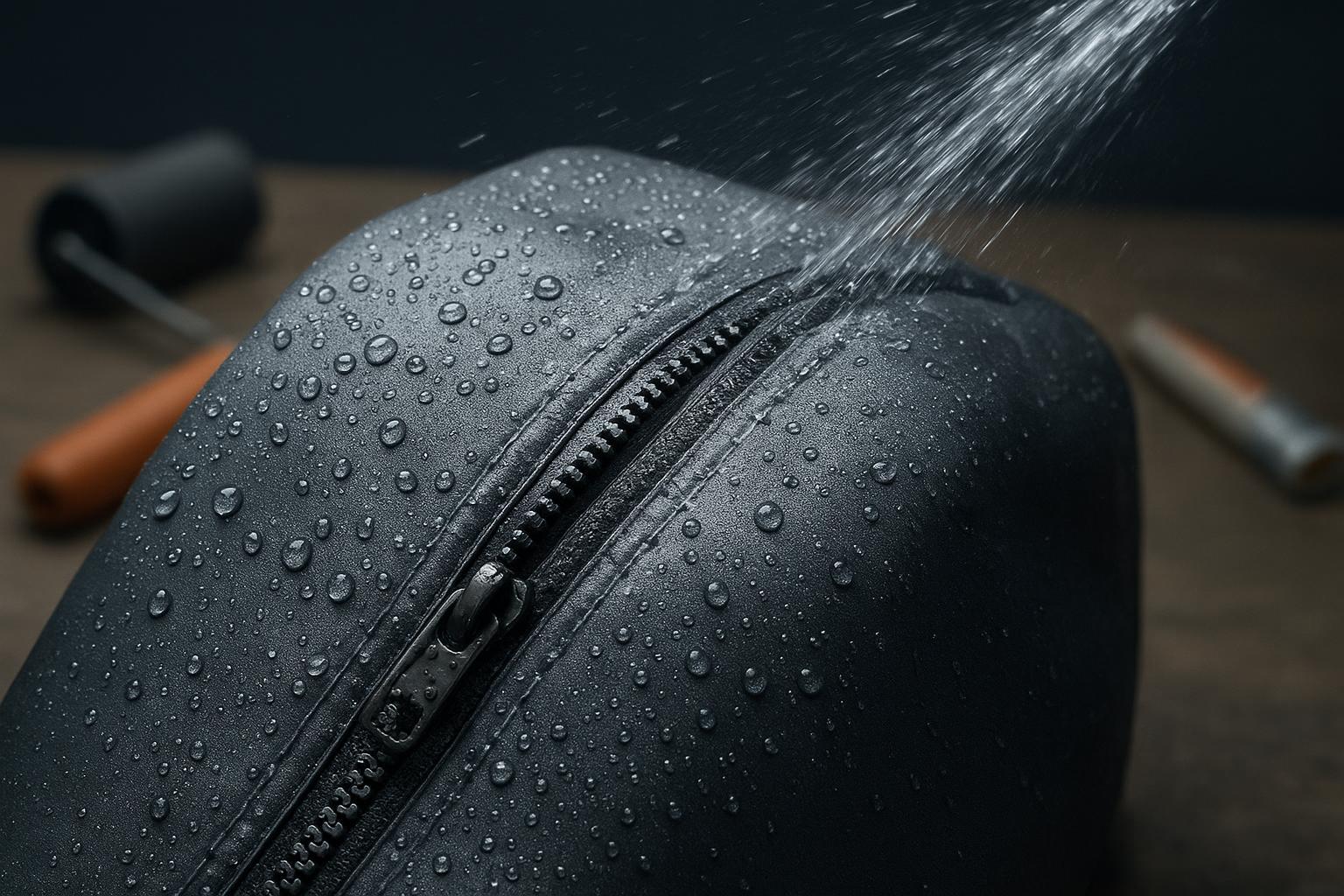
IPX5 hose approximation: Use a 6.3 mm nozzle at roughly 12.5 L/min from 2.5–3 m for at least 3 minutes overall, spraying from all directions. Afterward, open the cover and inspect for moisture inside. Parameters align with IEC 60529 summaries; see the concise Keystone IEC 60529 overview.
-
IPX7-style dip (field approximation): Submerge so the lowest point is ≤1 m below the surface (or ensure the top is at least 0.15 m below) for 30 minutes in fresh water, then dry the exterior and check for internal dampness. For scope and limits, see the Keystone guide to IPX7–IPX8 immersion.
-
Localized bubble check: Apply mild soapy water along the closed zipper and gently pressurize the interior (if safe) to spot bubbles at leaks. This borrows the principle of ASTM F2096-style leak detection used in packaging integrity evaluations.
Zipper specification checklist for IPX5–7 applications
-
Tape and coating: Use TPU-coated polyester tape that is weldable to the host fabric. Confirm coating thickness and compatibility with RF or hot-air/wedge sealing.
-
Chain/profile: Favor coil constructions for tighter bend radii and high-flex routes; select gauge based on load and durability (#5 for moderate duty, #8 for heavier duty).
-
Slider: Choose locking vs. non-locking based on use; ensure corrosion resistance where salt exposure is likely. Record new-part operating force as a baseline for future maintenance comparisons (ASTM D2061/D2062 provide test frameworks).
-
End seals and terminations: Specify sewn/melted stops plus seam-seal coverage; add storm flaps where appropriate to shield the chain from direct jets.
-
Accessories: Stock compatible seam-seal tapes, TPU hot-melt films, and TPU-safe cleaners/lubes.
-
Performance verification: Require IPX5 hose-test pass on assemblies; when occasional immersion is expected, validate with an IPX7-style check. For standard definitions and context, see Intertek’s IEC 60529 ingress protection overview.
Care and compatibility notes: OEM care documents advise closing zippers before wash, rinsing salt/dirt, air-drying, and using dedicated zipper lubricants rather than petroleum sprays. See YKK’s zipper instruction manual for representative guidance, and a common TPU-friendly cleaner/lube example like GEAR AID’s zipper lubricant. Always test on a hidden area first.
Neutral micro-example: retrofitting with a TPU-coated zipper
Scenario: You’re replacing a water-resistant zipper on a TPU-coated rain cover (IPX5 target) and have heat sealing available.
-
Prep: Clean the fabric and new zipper tape with isopropyl alcohol; lightly abrade where the hot-melt film will bond; dry thoroughly.
-
Alignment: Position a TPU-coated zipper (e.g., ZIZIP AquaSeal #8) so TPU faces align; tack in place using a TPU hot-melt carrier from the fabric side to avoid overheating elements. See the published specs on the ZIZIP AquaSeal Standard page.
-
Seal: Complete the perimeter seal with steady temperature, pressure, and dwell; maintain a 10–15 mm overlap; avoid direct iron contact with the chain.
-
End-termination: Create reliable stops (stitched or hotknife-melt as per your process) and cover any stitches with seam-seal tape to prevent wicking.
-
Verify: Perform the IPX5 hose check described above before releasing the cover back to service.
Field kit essentials (for site repairs and inspections)
|
Category |
Examples |
|---|---|
|
Sliders, stops, tools |
Spare sliders (#5/#8), top/bottom stops, FixnZip, seam ripper, small roller, hot-air tool |
|
Sealants and films |
Urethane adhesive (e.g., Aquaseal FD, 8–12 h cure), TPU hot-melt film, compatible seam-seal tapes |
|
Cleaning and care |
Soft brush, fresh-water rinse bottle, non-petroleum zipper lube, lint-free wipes |
Closing
Keep the zipper line clean, end seals sound, and verification routine simple—that’s “waterproof zippers maintenance” that actually sticks. For product specifications and material compatibility support, explore the waterproof zipper options on the ZIZIP site.