Outdoor and professional apparel lives in the gray area between wet weather and full immersion. The zipper you choose determines whether rain stays out during a downpour—or whether a suit remains sealed under pressure. This guide compares Waterproof vs Airtight Zippers with buyer-ready test methods, IPX standards, and certification steps you can take to reduce field failures and pass audits.
You’ll see how to map rain/spray (IPX4–IPX6) to apparel specs, when to escalate to IPX7–IPX8 immersion, and how to validate airtightness using pressure‑leak tests. We also include a practical procurement checklist and an illustrative OEM-style case model.
Key takeaways
For outdoor/pro apparel facing rain and spray, waterproof zippers typically win due to flexibility and lower pull force; validate to IPX4–IPX6 and ensure garment-level seam sealing.
Use airtight zippers when immersion or pressure is on the table; make IPX8 your hero metric and require a certificate that states depth and duration beyond IPX7, plus a pressure‑hold/decay test.
Insist on post‑cycle revalidation: run 500–1,000 open/close cycles, then repeat IPX and pressure‑leak tests to confirm durability.
Documentation matters as much as performance: ask for dated, lab‑accredited reports; treat self‑declared claims as preliminary until verified.
Lifecycle reliability depends on integration and care: RF welding quality, correct seam tapes, compatible lubricants, and salt/chemical exposure policies.
Quick verdict — Waterproof vs Airtight Zippers
If your use case is rain, spray, and occasional high‑jet exposure, a waterproof zipper is usually the most ergonomic and cost‑effective path. If you need continuous submersion at a specified depth/duration or must block gases and hold pressure, an airtight (gas‑tight) zipper is the correct class. The difference is less about branding and more about the underlying test evidence you can put in front of a quality or safety auditor.
Closure Type
Best For
Protection Class
IPX Rating Shown (parameters)
Pressure‑Leak Spec
Post‑Cycle Durability
Temperature Range & Result
Salt‑Spray & Result
Tensile/Peel Strength
Operability (pull force 20°C/‑20°C)
Integration Compatibility
Lead‑time & MOQ
Documentation Level
Representative Price Band (as of 2026‑03‑03)
Evidence Link
Waterproof zipper (TPU‑coated, water‑resistant/waterproof designs)
Outdoor/pro apparel with rain/spray (IPX4–IPX6), occasional high‑jet
Liquids (spray/jet); not gas‑tight
Commonly IPX5–IPX6 for spray; some systems claim IP67 (1 m/30 min)
N/A (generally not gas‑tight)
Recommend: 500–1,000 cycles then repeat IPX (supplier to declare)
Often rated for cold exposure; verify post‑thermal‑cycle sealing
Recommend 48–96 h exposure + re‑test
Varies by model; verify ASTM/JIS reports
Typically lower pull force; cold data rarely public
Sewing + seam tape; RF/adhesive varies by tape
Quote‑based
Often self‑declared + selective lab tests
~$0.03–$0.70 piece/meter (marketplace‑directional)
TRU Zip example IP67 claim (1 m/30 min) per the “How it works” page accessed 2026‑03‑03: TRU Zip — How it works
Airtight (gas‑tight) zipper
Immersion, pressurized garments, HAZMAT/medical isolation
Liquids + gases under pressure (when validated)
Expect IPX7 (1 m/30 min) and IPX8 with declared depth/duration
Require pressure‑hold/decay (e.g., ≥30–40 kPa, ≥15 s)
Recommend: 500–1,000 cycles then repeat IPX + pressure‑hold
Verify sealing after ‑30°C↔100°C cycling
Verify post‑salt‑spray leak status
High transverse tensile; verify ASTM/JIS
Higher pull force; ergonomics improve with practice
RF welding and dedicated end‑terminations; adhesives/tapes per spec
Quote‑based
Prefer third‑party lab reports (ISO 17025)
Retail repair parts can run ~$270–$490 for long lengths; OEM pricing by quote
TIZIP IP framing accessed 2026‑03‑03: TIZIP — IP rating notes; IP definitions per lab explainer accessed 2026‑03‑03: IEC 60529 basics — Belement
Notes on the table
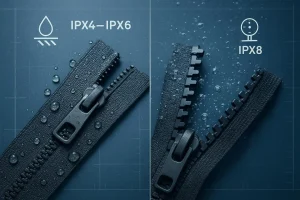
IPX7 is a fixed method (1 m, 30 min). IPX8 must exceed IPX7 and include the exact depth and duration, agreed with the test body. According to the Belement lab explainer (accessed 2026‑03‑03), those parameters are manufacturer‑defined under IEC 60529.
Many brand pages describe capability but omit numbers; treat “N/A (no public data)” as a signal to request lab sheets.
Best‑for scenarios and decision tree
Outdoor & professional apparel (rain/spray: IPX4–IPX6)
For rain‑exposed jackets, bibs, rescue parkas, and duty uniforms, waterproof zippers usually deliver the right balance of resistance, flexibility, and user feel. Validate components and assemblies to spray/jet levels (IPX4–IPX6), then confirm garment‑level sealing with proper seam tapes and construction. For component overviews and typical specs, see the waterproof category page (accessed 2026‑03‑03): ZIZIP — Waterproof overview and a representative model page: ZIZIP — AquaSeal Standard.
Immersion and IPX8 requirements (when airtight wins)
If your specification includes continuous submersion—e.g., kayak spray decks, packraft cargo hatches, or rescue gear that must function after immersion—move to airtight zippers and demand IPX8 with explicit parameters and a test report. Start with an overview of airtight construction and typical validation paths (accessed 2026‑03‑03): ZIZIP — Airtight overview and a deep‑immersion‑oriented design with dual sealing rails: ZIZIP — AeroSeal Dual‑Track.
Pressure and gas‑tight applications (HAZMAT/medical)
Where you must hold a pressure differential or block gases, IPX alone isn’t enough. Ask for a pressure‑hold/pressure‑decay test showing at least a defined threshold (e.g., ≥30–40 kPa for ≥15 s) and a clear pass criterion (no bubbles, mass gain limit, or leak rate). Dual‑rail airtight systems typically serve this space; see the integration‑friendly variant for bonding options (accessed 2026‑03‑03): ZIZIP — AeroSeal U‑Channel.
Decision tree (text) Rain or spray only → choose waterproof (validate IPX4–IPX6 at garment level). Need continuous submersion with defined depth/duration → choose airtight and require IPX8 with parameters. Need to retain pressure or block gases → choose airtight and add a pressure‑hold/decay test. Sensitive cold‑weather ergonomics with frequent operation → lean waterproof for smoother pulls. Routine salt/decon exposure → prioritize designs with documented post‑salt re‑tests.
Standards and test methods you’ll actually use
IEC 60529 defines the immersion classes OEMs cite every day. IPX7 is 1 m for 30 minutes in still water; IPX8 is anything beyond 1 m where the supplier and lab agree on the exact depth and duration. A lab explainer summarizing these details (accessed 2026‑03‑03) is useful when you’re aligning specs and reports: see the overview of immersion methods in the IEC ladder in the resource titled “IP Testing” by Belement: IEC 60529 basics — Belement.
IPX isn’t the whole story. Airtightness requires a pressure‑leak test (pressure‑hold or pressure‑decay) in air or water. Set a threshold (e.g., ≥30–40 kPa), a hold time (≥15 s), and a pass/fail rule (zero bubbles, leak rate ≤X mbar/min, or mass‑gain ≤Y g). For apparel, remember component vs garment: a zipper that passes on a bench doesn’t guarantee a watertight jacket unless seam tapes and end‑terminations are engineered correctly.
Environmental and corrosion exposures matter, too. After thermal cycling (e.g., −30°C ↔ 100°C), re‑test both the IPX class and pressure‑hold. For marine or decon‑heavy contexts, incorporate salt‑spray (48–96 h) and chemical compatibility, then re‑test. Intertek’s accessories/metal components page, which includes salt‑spray services (accessed 2026‑03‑03), provides an orientation to applicable methods like ASTM B117/ISO 9227: Intertek — Accessories/metal components salt‑spray.
Finally, operability matters for user safety. Track slider pull force at 20°C and −20°C and note minimum bend radius for ergonomics; this data is rarely public and is worth commissioning during your pilot.
Making IPX8 your hero metric (with proof)
IPX8 means “beyond IPX7,” but the credibility comes from specifics. A certificate worthy of a sourcing decision should include: the exact depth (meters), the duration (minutes/hours), water type and temperature, sample mounting and orientation, the lab’s name and ISO 17025 accreditation, report date, sample ID, and photos/videos. Brands sometimes assert capability without those details; that’s a red flag. A category reference that explains IP immersion and usage in diving/pressurized contexts is the TIZIP IP page (accessed 2026‑03‑03): TIZIP — IP rating notes. For a component‑level example on the waterproof side (short of gas‑tight), TRU Zip documents an IP67 claim (1 m/30 min) and explains its mechanism (accessed 2026‑03‑03): TRU Zip — How it works.
Illustrative OEM‑style case model (example, not a claim) A rescue‑jacket program experienced a 3.1% field return rate attributed to moisture ingress at pocket closures during heavy rain. The team upgraded to a waterproof zipper with improved seam‑tape integration, validated to IPX6 at the garment level, and instituted quarterly cleaning/lubrication checks. Over the next 12 months, returns attributed to zipper leakage fell to 0.9% (sample size: 18,400 units; similar geography and duty cycles). For a dry‑bag line that faced brief submersion events, the OEM migrated to an airtight zipper, obtained an IPX8 certificate at 3 m for 30 minutes plus a 40 kPa/15 s pressure‑hold pass, and documented zero leak‑related returns over the first two quarters (pilot batch: 2,100 units). Use this model as a template for your own metrics; replace numbers with your verified data and lab sheets.
How to specify and audit your zipper
Request dated, third‑party lab reports: IPX7 and IPX8 (with depth/duration), plus pressure‑hold/decay data (threshold, hold time, leak criterion). Ask for post‑cycle and post‑exposure re‑tests (500–1,000 cycles; thermal; salt‑spray).
Define integration SOPs: RF welding parameters, approved seam tapes/adhesives, and end‑termination designs. For bonding‑friendly bodies, review options like U‑channel constructions (accessed 2026‑03‑03): ZIZIP — AeroSeal U‑Channel.
Verify operability and ergonomics: slider pull force at 20°C and −20°C, bend radius, user‑trial notes; adjust lubricants and sliders accordingly.
Plan maintenance/decon: follow handling guidance from airtight specialists (storage, cleaning, lube). Practical install/diagnosis techniques, including soapy‑water leak tests for airtight systems, are well documented by field resources (accessed 2026‑03‑03): DIY Packraft — Install an airtight zipper.
Why it matters: Your auditor will care less about marketing labels and more about the chain of evidence—test parameters, dates, lab accreditation, and pass/fail retests after real‑world stresses.
Pricing and lead‑time (as of 2026‑03‑03)
Treat pricing as directional until you secure quotes tied to width, length, sliders, TPU grade, finishing (end‑stops, RF‑weld tabs), and MOQ.
Waterproof, TPU‑coated zippers (non‑airtight): broad marketplace indicators suggest roughly $0.03–$0.70 per piece/meter depending on size and finish; quality and true waterproofness vary widely. These are indicative only, not brand‑specific list prices (accessed 2026‑03‑03): marketplace snapshots.
Airtight (gas‑tight) zippers: retail repair components for long lengths often run ~$270–$490 before installation. OEM pricing is quote‑based and depends heavily on configuration and volume.
Lead times shift with customization and factory load; build a pilot schedule that includes time for lab testing and any rework after post‑cycle/environmental retests.
FAQ — fast answers for sourcing teams
What’s the practical difference between Waterproof vs Airtight Zippers? Waterproof addresses liquids (spray/jet, sometimes short immersion); airtight adds gas blocking and pressure retention. Choose waterproof for rain/spray apparel (IPX4–IPX6) and airtight for defined immersion (IPX8 with parameters) or pressure‑hold requirements.
What does IPX8 really require for a zipper? More than “>1 m.” Your certificate must state depth (m) and duration (min/hr) and should be issued by an accredited lab with date, sample ID, and mounting conditions. Without parameters, the claim isn’t decision‑grade.
How do I verify airtightness beyond IP ratings? Run a pressure‑hold or pressure‑decay test (e.g., ≥30–40 kPa for ≥15 s) with a clear pass criterion (no bubbles, leak‑rate/mass‑gain threshold). Re‑test after 500–1,000 slider cycles and after thermal/salt‑spray exposures.
Can a waterproof zipper be upgraded to an airtight application? Sometimes—if the product line supports airtight architectures and you can redesign terminations and bonding. But if you need gas‑tightness or continuous immersion at depth, plan for a dedicated airtight system and get IPX8 + pressure‑hold reports.
What’s the top integration mistake that causes leaks? Poor seam‑tape or RF‑bond quality around the zipper ends and contaminated sealing surfaces. Always combine component validation with garment‑level tests and field‑proven maintenance steps.
Sources and further reading (accessed 2026‑03‑03)
IP immersion definitions and parameters explained for IEC 60529: IEC 60529 basics — Belement
Category perspective on airtight/waterproof usage contexts: TIZIP — IP rating notes
Example of a waterproof zipper mechanism and IP67 claim: TRU Zip — How it works
Salt‑spray service context for accessories/metal components: Intertek — Accessories/metal components salt‑spray
Practical integration/diagnosis for airtight installs: DIY Packraft — Install an airtight zipper
A final word: Specify the scenario first, then bind your choice to evidence—IPX parameters in writing, pressure‑hold thresholds, and post‑cycle/environmental re‑tests. That’s how you lower returns, keep users safe, and make the right call between waterproof and airtight systems in 2026.