Designing a soft cooler or insulated delivery bag lives and dies by its closure. The wrong zipper can sabotage airtightness, bleed thermal performance, and create a stiff, frustrating user experience. This guide lays out repeatable tests, practical target ranges, and decision rules so OEM product managers and engineering teams can specify zippers with confidence—and back those choices with data.
Key takeaways
- Treat the closure as a system: zipper geometry, baffles/overlaps, and terminations jointly control leakage and heat flow.
- Anchor specs to measurable targets: IPX7/8-style immersion, a quick pressure-hold screen, opening force in newtons, and ≥10,000-cycle durability.
- For delivery-first access, cap opening force near 20–25 N and compensate with thermal design (foam collars, internal baffles) to protect retention.
- For hermetic transport, accept higher opening force envelopes; require pressure-hold and IPX8-like immersion with assisted opening hardware.
- Standardize a 30°C, 2:1 ice:water thermal bench to quantify how closure changes affect real retention.
Why closures govern “soft cooler zipper airtight thermal performance user experience”
Closures dictate two dominant loss paths: microleaks (air exchange) and thermal bridges (conduction near the zipper path and slider). Airtight, toothless TPU-coated designs reduce convection losses but usually raise opening force. Coil or water-resistant zippers feel easier to pull yet leak more unless paired with baffles and foam collars. Hygiene adds another dimension: toothless profiles and welded terminations minimize crevices and speed cleaning, which matters for food service.
According to widely cited summaries of IEC 60529, IPX7 is defined as 1 m immersion for 30 minutes with no harmful ingress, and IPX8 is a more severe, mutually agreed immersion condition beyond IPX7. See overviews from labs and standards explainers such as the Keystone Compliance guide to IPX7/IPX8 and similar IP immersion summaries aligned to IEC 60529. For engineering validation, combine immersion with a simple pressure-hold screen so you can quantify leak-down in kPa rather than rely only on pass/fail observations.
Quick spec bands you can start from
| Attribute | Target bands for soft coolers and delivery bags |
|---|---|
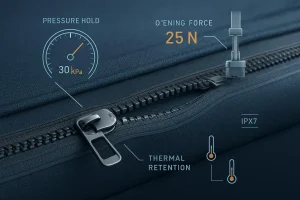
| Airtightness | IPX7 (1 m, 30 min); define IPX8 case-by-case. Add a pressure-hold screen at 20–30 kPa with Δp ≤ 2–3 kPa over 30 s as a first-line check. |
| Opening force (N) | Delivery-first: ≤20–25 N preferred; Balanced: 20–60 N; Hermetic-biased: >60 N acceptable with assisted opening. Report peak and steady values. |
| Durability | ≥10,000 cycles baseline; re-qualify IPX/pressure at 1k/5k/10k/20k checkpoints. |
| Thermal bench | 30°C ambient, 2:1 ice:water by mass, pre-chilled interior; log temps 0–24 h; compute heat influx (W). |
| Hygiene | Toothless TPU-coated profiles, welded seams/terminations; verify materials and cleanability when food contact is intended. |
These starting points should be adapted to your use case through design of experiments (DOE) and field validation.
Test protocols you can reproduce
1) IPX-style immersion
- Objective: Verify ingress resistance of the full bag/zipper assembly.
- Method: IPX7 = 1 m, 30 min in still water; unit stationary; pass criterion is “no harmful ingress.” IPX8 = define depth/time more severe than IPX7 and document explicitly. For public explanations aligned with IEC 60529, see lab overviews and standards summaries of IPX7 and IPX8 including the Keystone Compliance overview.
2) Pressure-hold screen (zipper + bag cavity)
- Equipment: Low-pressure regulator and gauge, quick-connect, optional leak spray.
- Procedure: Pressurize to 20–30 kPa gauge, stabilize 10 s, then hold 30–60 s. Record Δp.
- Initial acceptance: Δp ≤ 2–3 kPa over 30 s as a screening threshold. Tighten once you correlate with immersion and field tests.
3) Opening force (N) with a tensile tester
- Fixture: Clamp tapes to isolate slider motion; hook the pull tab.
- Precondition: 10 manual cycles.
- Test speed: 300–500 mm/min constant-rate extension.
- Output: Peak and steady-state pull (N) averaged over 3–5 runs; include force–displacement plots. For zipper test frameworks, see ASTM D2061 (zipper strength tests) record and, for gross-leak screening concepts in flexible packages, ASTM D3078 vacuum bubble test explainers.
4) Cycle durability
- Rig: Reciprocating actuator with defined lateral/axial loads on the slider.
- Plan: Run to ≥10,000 cycles (or 20,000 for heavy-duty). Pause at 1k/5k/10k/20k for IPX/pressure re-tests and visual inspection of sealing lips and terminations.
- Optional: Temperature/humidity cycling (e.g., −20°C to +50°C) to expose seal set drift.
5) Thermal retention bench (30°C, 2:1 ice:water)
- Setup: Pre-chill interior to ~5–10°C. Load 2:1 ice:water by mass to ~50–60% volume; add a dummy payload mass typical of use. Place thermocouples at center air, near zipper path, opposite wall, bottom liquid, and near lid seam.
- Environment: 30°C still air room. Log 0–24 h at 1–5 min intervals; weigh meltwater to estimate melt rate.
- Analysis: Compare variants (zipper tech, internal baffles, foam collars) using temperature curves and computed heat influx (W). Consumer-facing product pages frequently cite ~32°C tests under EN 12546-2; for context, see a Decathlon explainer referencing EN 12546‑2 practices.
Micro-examples: how to pick the right closure for the job
A) Last‑mile meal delivery — fast access priority
- Targets: 8 h hold at 30°C; opening force peak ≤25 N; durability ≥10,000 cycles; IPX7 splash resistance; no gross leaks under a vacuum bubble check.
- Design: Toothless TPU-coated zipper with a continuous foam collar at the closure line; internal overlap baffle; oversized pull tab for one-hand starts; welded liner seams at terminations to minimize crevices.
- Validation plan: Opening-force test as above; pressure-hold at 20 kPa, 30 s with Δp ≤ 2 kPa; thermal bench with 2:1 ice:water; durability checkpoints at 1k/5k/10k.
- Expected trade-offs: Lower opening force improves route efficiency but slightly raises convection leakage; compensate with baffles and foam collars.
B) Multi‑stop grocery delivery — balance seal and wear
- Targets: 10–12 h retention at 30°C; opening force 20–35 N; ≥20,000 cycles; IPX7.
- Design: Reinforced slider metallurgy; abrasion-resistant tape; double-overlap flap; scheduled lubrication/cleaning to preserve seal continuity.
- Validation plan: Same as A with a higher cycle target and post-cycle IPX/pressure re-qualification.
- Expected trade-offs: Mid-band opening force yields better leakage control with acceptable pull effort; maintenance discipline becomes more important.
C) High‑assurance transport — hermetic bias with assisted opening
- Targets: >24–48 h at 30°C; IPX8 immersion defined (e.g., >1 m, >30 min); pressure-hold 30 kPa, Δp ≤ 1 kPa over 60 s; ≥10,000 cycles.
- Design: Dual-track or equivalent hermetic zipper geometry; reinforced terminations; levered pull hardware or single-hand mechanisms to manage higher forces; thermal isolation cover for the slider.
- Example reference: In this class, some engineered, toothless TPU-coated zippers with redundant sealing paths are designed to support IPX7/8-style immersion and pressure-hold steps when validated at the assembly level. For context, review the dual-track hermetic description from ZIZIP’s AeroSeal Dual‑Track as an engineering example; validate performance on your own assembly before specification.
Component considerations (OEM lens)
Zipper geometry drives the seal mechanics. Toothless TPU-coated chains compress into continuous lips that resist convection but tend to increase pull effort; coil water‑resistant designs pull easier but rely on baffles and foam collars to curb leakage; dual‑track hermetic geometries add redundancy for higher pressure resistance at the cost of higher opening forces and tighter assembly tolerances. Match tape width and stiffness to your seam stack‑up so baffles compress predictably. Choose slider metallurgy and coatings for corrosion and wear while watching thermal conductivity; a small insulating cover can blunt thermal bridging around the slider head. Reinforce terminations to avoid pinch gaps, and keep maintenance in mind—oversized pulls and access for periodic cleaning and lubrication preserve sealing continuity in the field.
Hygiene and maintenance notes
If the bag is intended for contact with unpackaged foods, confirm materials against applicable food‑contact frameworks (for example, the U.S. FDA 21 CFR parts 175–178 inventory or EU 10/2011 lists) and run migration/extraction with proper simulants and time/temperature profiles. For cleanability, soil the closure with a dyed solution, clean per SOP, and verify with ATP or microbial counts. Toothless profiles and welded terminations typically reduce residue traps and speed cleaning.
A simple decision flow to converge on a zipper type
- Define the thermal target at 30°C ambient (e.g., 8 h, 24 h, 48 h) and document it with your standardized bench. This keeps the focus on soft cooler zipper airtight thermal performance user experience as a system metric.
- Choose an opening‑force envelope that matches the workflow (≤25 N for frequent access, mid‑band 20–60 N for balance, >60 N allowed if assisted).
- Set immersion and pressure‑hold acceptance (IPX7 minimum; IPX8 as needed; pressure‑hold Δp targets for your cavity volume).
- Prototype two zipper geometries plus one control with baffles/foam collar variations.
- Run the standardized tests (immersion, pressure‑hold, opening force, durability checkpoints, thermal bench) and select on total system performance rather than a single metric.
Pre‑production test essentials (lab wall version)
- IPX‑style immersion defined and documented (depth/time) with pass/fail notes.
- Pressure‑hold screen at 20–30 kPa; Δp thresholds defined and correlated to immersion.
- Opening‑force characterization: peak and steady, tested at set speed, with plots saved and means ± SD reported.
- Durability cycling to ≥10,000 with IPX/pressure re‑tests at intervals and post‑cycle inspections of sealing lips/terminations.
- Thermal bench at 30°C with 2:1 ice:water; multi‑point thermocouples; heat influx calculated from melt rate and ΔT.
- Hygiene validation: materials listings; cleanability SOP with ATP/microbial verification and documented time‑to‑clean.
Engineers’ note: Public lab explainers consistently summarize IPX7/IPX8 in line with IEC 60529, and zipper strength/operability frameworks are described in ASTM references. Use those documents for framing and anchor your own acceptance bands with data correlations from your assemblies.
Next steps: Build two zipper variants and a control with and without a continuous foam collar, run the five tests above, and select the configuration that meets both retention and opening‑force goals. If you’re sourcing hermetic or low‑force TPU‑coated options, request engineering samples and datasheets from shortlisted suppliers and validate on your own assembly before committing tooling.